Katalog
Ventilators serve as life-support devices where stable operation directly relates to patient safety. The WF200DP medical pressure sensor ensures perfect synchronization between equipment and patient breathing patterns through precise airway pressure monitoring and real-time feedback control. This MEMS-based differential pressure sensor has become an indispensable core component in modern ventilator systems due to its high accuracy, rapid response, and long-term stability.
1. Critical Role of MEMS Technology in Ventilators
Medizinische Bedeutung der Drucküberwachung
Ventilators create artificial pressure differentials to replace natural respiratory function. During normal breathing, inspiration creates negative pressure through chest expansion, while expiration generates positive pressure through alveolar elastic contraction. The WF200DP sensor precisely replicates this physiological process, ensuring accurate assessment of patient respiratory needs through real-time airway pressure monitoring.
Prinzipien der Differenzdruckerkennung
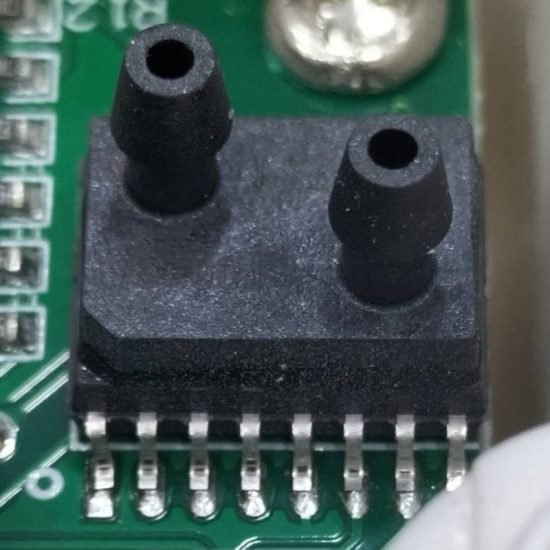
WF200DP employs differential pressure detection technology, simultaneously monitoring pressure differences between two ports. This design enables the sensor to eliminate environmental temperature and atmospheric pressure variations, providing more stable and accurate measurement results. Internal silicon diaphragms undergo minute deformation under pressure, converting mechanical signals to electrical signals through piezoresistive effects.
Signalverarbeitung und Steuerungsrückmeldung
Sensor-generated analog signals undergo amplification and digital conversion before transmission to the ventilator’s microcontroller unit. The MCU analyzes pressure data to assess patient respiratory status, adjusting motor speeds and valve openings to control airflow supply and discharge, achieving precise synchronization with patient breathing.
2. WF200DP Sensor Technical Advantages
Hochpräzise Messfähigkeit
WF200DP sensors feature ±0.25% measurement accuracy, detecting extremely minute pressure variations. This precision level proves crucial for ventilator applications, as patient respiratory pressure changes often involve only hundreds of pascals, requiring sufficient sensor sensitivity to accurately capture these variations.
Schnelle Reaktionseigenschaften
Sensor response times under 1 millisecond enable real-time tracking of rapid patient respiratory cycle changes. This rapid response capability ensures ventilators can promptly adjust output parameters, preventing patient discomfort or reduced treatment effectiveness due to delays.
Langfristige Stabilitätssicherung
Medical equipment typically requires continuous operation for thousands of hours. WF200DP sensors undergo extensive long-term stability testing, with zero-point drift and full-scale drift controlled within minimal ranges, ensuring consistent measurement accuracy during extended use periods.
3. Ventilator System Integration and Control
Kollaborative Überwachung mehrerer Parameter
Modern ventilators monitor not only pressure but also flow, temperature, humidity, and other parameters. WF200DP sensors work collaboratively with other sensors, providing comprehensive physiological parameter monitoring for treatment safety and effectiveness.
Intelligente Steuerungsalgorithmen
Sensor data feeds into advanced control algorithms enabling automatic patient breathing pattern recognition and adjustment of respiratory rate, tidal volume, and positive end-expiratory pressure parameters. This intelligent control significantly reduces healthcare staff workload while improving treatment outcomes.
Sicherheitsschutzmechanismen
When sensors detect abnormal pressure values, ventilators immediately activate safety protection programs including pressure limitation, flow cutoff, and alarm notifications. These safety mechanisms effectively prevent medical accidents caused by equipment failure or operational errors.
4. Medical Application Scenarios and Performance Requirements
Intensive Pflegeeinheiten Anwendungen
ICU environments present complex, rapidly changing patient conditions demanding extremely high ventilator response speed and accuracy. WF200DP sensors adapt to various complex clinical situations, providing stable, reliable respiratory support for critically ill patients.
Tragbare Integration der Beatmungsgeräte
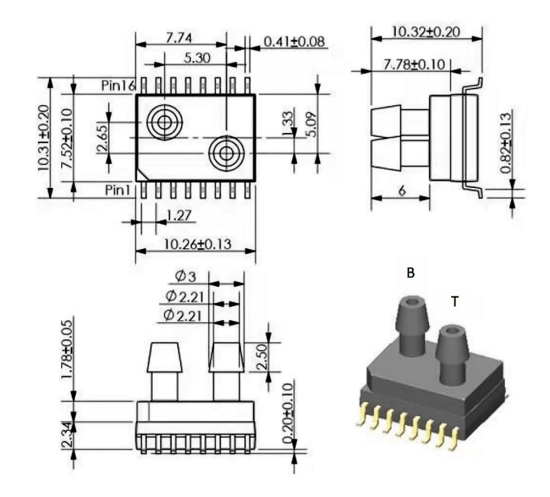
Medical equipment miniaturization trends impose higher volume and power consumption requirements on sensors. WF200DP sensors feature compact packaging design with extremely low power consumption, fully meeting portable device stringent requirements.
Marktbeatmungsmarkt
Rapid growth in home ventilator markets presents new challenges for sensor reliability and cost control. WF200DP sensors achieve effective cost control through scaled production and process optimization while maintaining high performance, enabling high-quality respiratory therapy equipment accessibility to more households.
5. Quality Assurance and Certification Standards
Zertifizierung von Medizinprodukten
WF200DP sensors comply with ISO 13485 medical device quality management system requirements and pass FDA, CE, and other international authoritative certifications. Strict quality control processes ensure every sensor meets demanding medical application requirements.
Biokompatibilitätstests
Sensor materials undergo rigorous biocompatibility testing, ensuring no harmful reactions during human contact. Housing materials utilize medical-grade polymers with excellent corrosion resistance and chemical stability.
Überprüfung der Umweltanpassungsfähigkeit
Medical environments demand exceptional equipment environmental adaptability. WF200DP sensors undergo comprehensive testing including temperature cycling, humidity, vibration, and electromagnetic compatibility, ensuring stable operation in various complex medical environments.
Abschluss
WF200DP medical pressure sensors provide accurate, stable, reliable pressure monitoring for ventilators through advanced MEMS technology. High-precision measurement capability, rapid response characteristics, and long-term stability ensure ventilators accurately respond to patient respiratory needs, providing safe, effective respiratory support.
Die obige Einführung kratzt nur an der Oberfläche der Anwendungen der Drucksensortechnologie. Wir werden weiterhin die verschiedenen Arten von Sensorelementen untersuchen, die in verschiedenen Produkten verwendet werden, wie sie funktionieren und welche Vor- und Nachteile sie haben. Wenn Sie detailliertere Informationen zu den hier besprochenen Themen wünschen, können Sie sich die entsprechenden Inhalte weiter unten in diesem Handbuch ansehen. Wenn Sie unter Zeitdruck stehen, können Sie auch hier klicken, um die Details dieser Leitfäden herunterzuladen PDF -Daten des Luftdrucksensorprodukts.
Weitere Informationen zu anderen Sensortechnologien finden Sie hier Besuchen Sie unsere Sensors -Seite.
-e1747998312687.jpg)