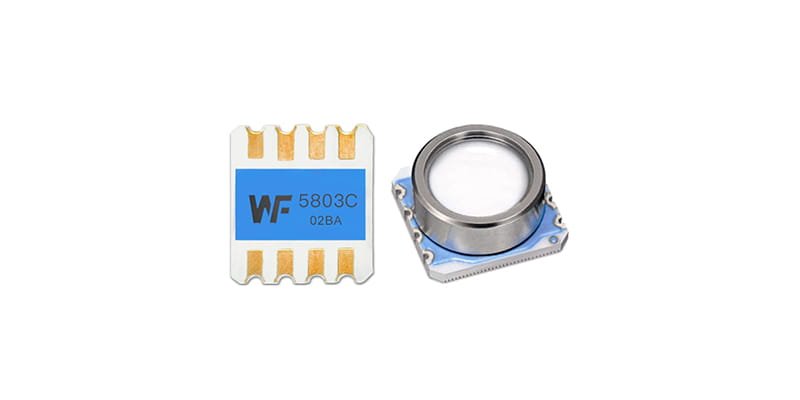
Altitude is a fundamental geographical parameter used in operational decision-making across aerospace, the low-altitude aviation economy, surveying and exploration, wearable devices, and Industrial Internet of Things (IIoT) applications.
Based on hydrostatic equilibrium and the International Standard Atmosphere (ISA) model, barometric altimetry has become a widely adopted technology for altitude measurement. Its advantages include offline operation, real-time performance, low deployment costs, and broad applicability.
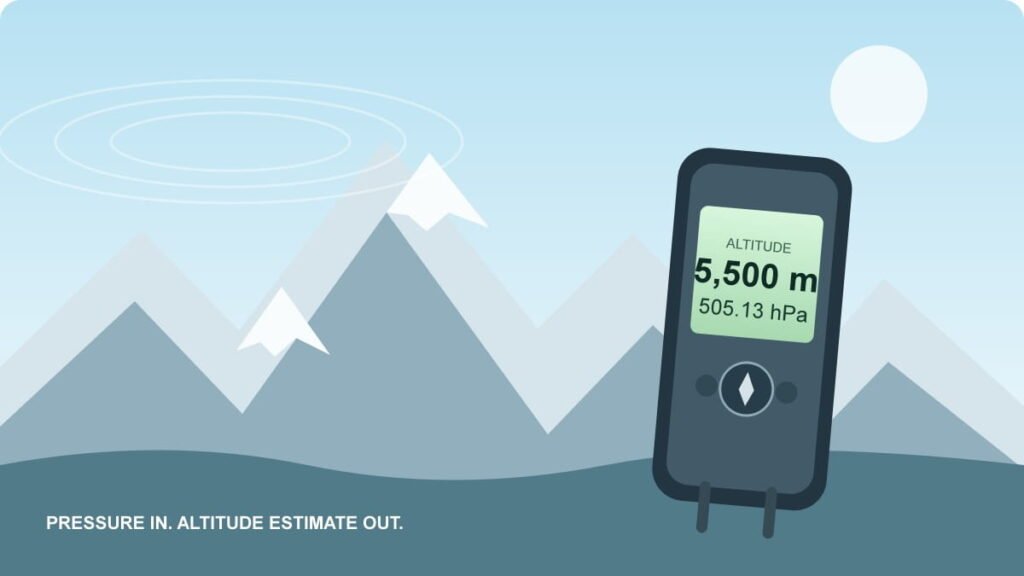
As industries increasingly embrace digitalization, intelligence, and low-power technologies, barometric altimetry continues to evolve from basic altitude estimation toward higher accuracy, greater reliability, multi-sensor fusion, and miniaturized integration. Digital barometric pressure sensors are the core sensing components that convert atmospheric pressure measurements into altitude estimates. By providing precise pressure measurements and supporting altitude calculations, they serve as a fundamental hardware component for technological advancement and real-world applications.
1. WF5837F: The Core Sensing Component for Altitude Measurement
Digital barometric pressure sensors are now widely used in aircraft altitude control, indoor floor detection, environmental and meteorological monitoring, and altitude displays for mountaineering. By providing stable and reliable pressure measurements and altitude information, these sensors supply essential data for altitude awareness, motion control, and safety-related decisions in intelligent systems.
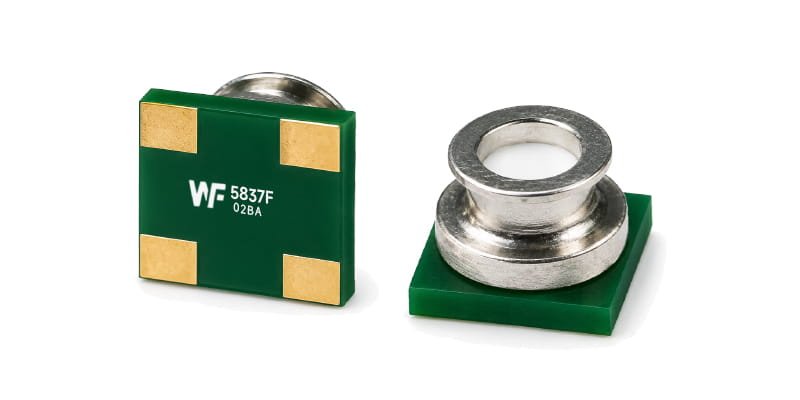
For example, the WF5837F is a precision pressure sensor designed for high-performance barometric altimetry applications.
The device features a high-resolution 24-bit ADC and a MEMS pressure-sensing architecture with an I2C interface. It offers a wide pressure measurement range of 0–2000 mbar and a pressure resolution of 0.01 mbar, enabling fine-grained digital pressure measurement.
The WF5837F also supports temperature measurements from −40°C to 125°C, with a temperature resolution of 0.01°C. These capabilities provide a foundation for accurate temperature compensation during altitude calculations.
Within a pressure range of 300–1200 mbar and a temperature range of −10°C to 60°C, the WF5837F achieves a relative pressure accuracy of ±1.5 mbar and an absolute pressure accuracy of ±3.0 mbar.
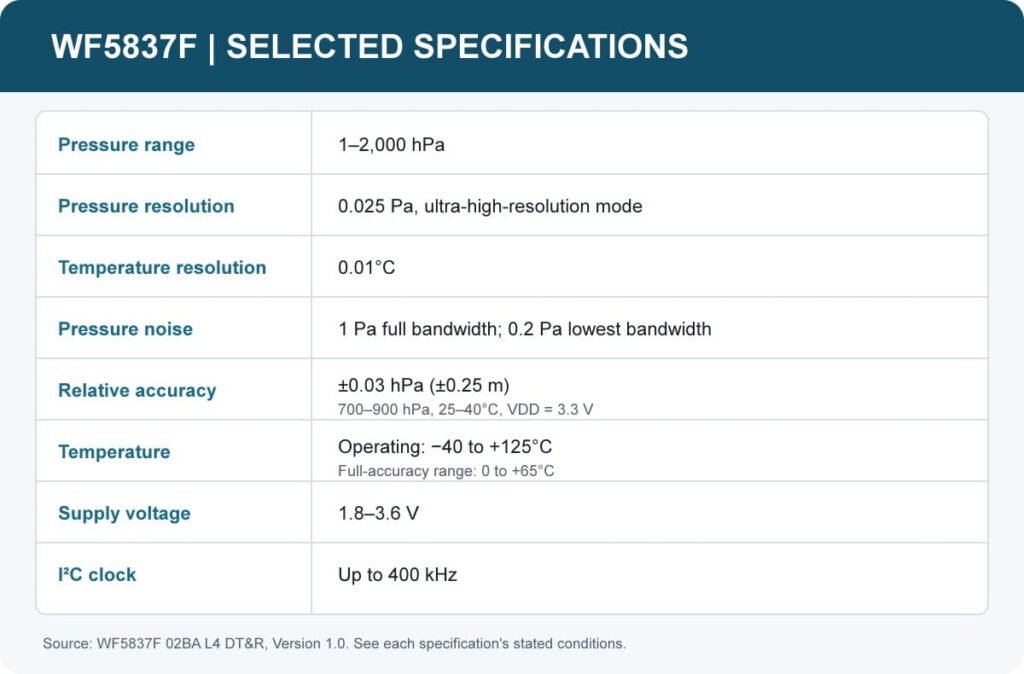
In addition, developers can configure the oversampling ratio (OSR) through register read and write operations. With selectable OSR settings from 128 to 4096, the WF5837F allows developers to balance measurement accuracy and response speed according to application requirements. Pressure and temperature conversion times can be adjusted within a range of 4.1–131.1 ms, accommodating different real-time performance requirements.
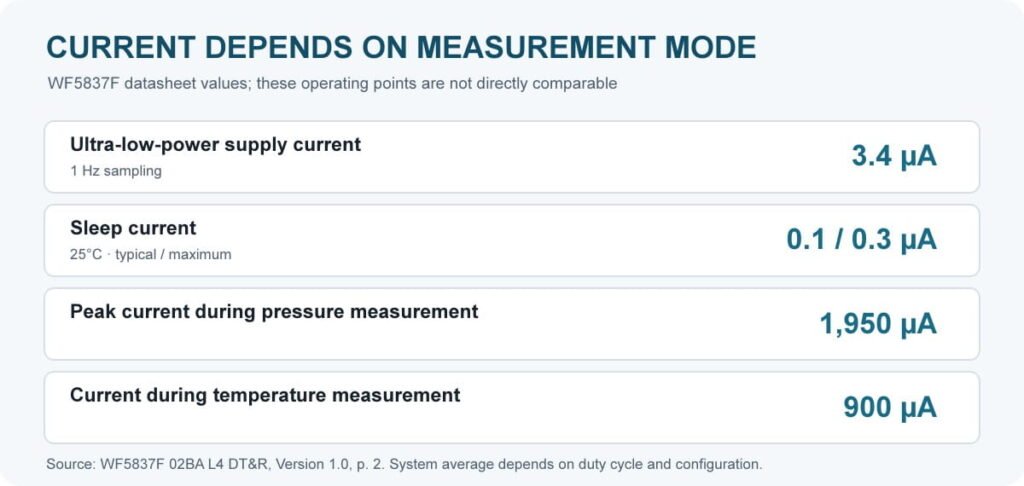
The WF5837F also offers low-power operation. Its supply voltage ranges from 1.8 V to 3.6 V, while its typical measurement current (IDDAVP) is only 5.3 µA at OSR = 256. Standby current is as low as 0.1 µA, making the device suitable for battery-powered wearable products, IoT nodes, and compact unmanned aerial vehicle (UAV) systems.
Note: Each WF5837F sensor is individually calibrated for pressure and temperature sensitivity and zero-point offset before leaving the factory. The calibration coefficients are stored in an integrated 128-byte non-volatile memory (NVM). Automatic initialization at power-up can further simplify system design and integration.
Through its I2C digital interface, supporting communication speeds of up to 400 kHz, the sensor allows an external microcontroller to conveniently read compensated pressure and temperature data. It can also provide access to an integrated altitude calculation algorithm, reducing the computational burden on the MCU and shortening product development cycles.
2. Digital Barometric Pressure Sensors: A High-Performance Solution for Altitude Measurement
Digital barometric pressure sensors are the physical sensing interface and primary data source for pressure-based altitude measurement. They perform key functions throughout the measurement chain, including pressure acquisition, analog-to-digital conversion, temperature compensation, and digital data output. Their performance directly affects altitude calculation accuracy, response speed, stability, and power consumption.
According to the principle of hydrostatic equilibrium, atmospheric pressure and air density generally decrease as altitude increases. By using this relationship, altitude can be estimated from atmospheric pressure measurements under appropriate atmospheric conditions.
The International Standard Atmosphere (ISA) model also establishes a relationship between pressure, temperature, and altitude. Under standard atmospheric conditions, this relationship follows a nonlinear, approximately exponential pattern.
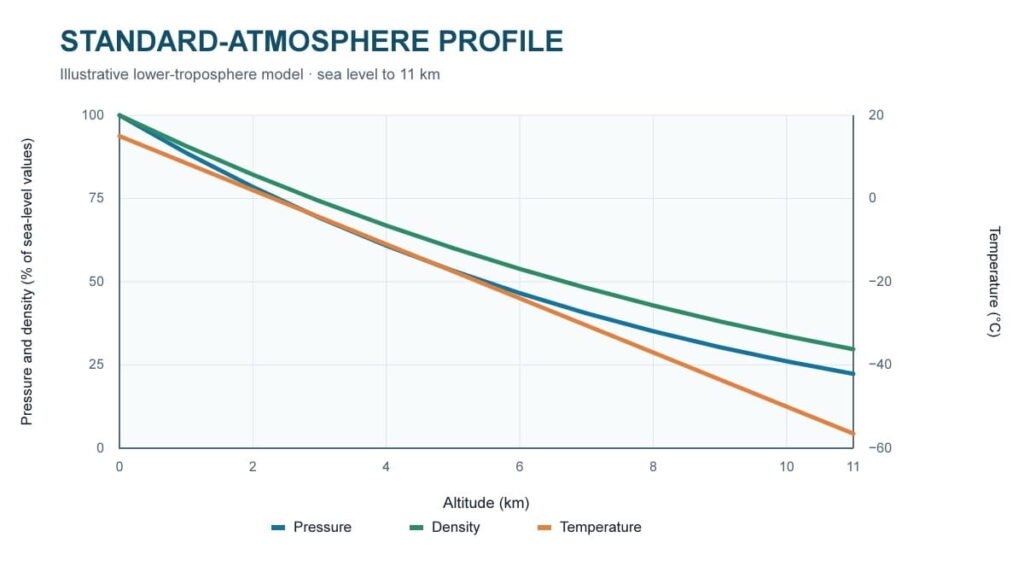
Figure caption: Relationships between atmospheric pressure, air density, temperature, and altitude. Source: Wikipedia.
A commonly used engineering approximation suggests that, in the standard troposphere, a pressure decrease of approximately 1 hPa corresponds to an altitude increase of about 8–9 meters.
This means that a pressure resolution of 0.1 hPa can theoretically support meter-level altitude resolution. If pressure resolution improves to 0.01 hPa, the theoretical altitude resolution can reach the decimeter range.
Therefore, when a digital barometric pressure sensor can acquire low-noise, high-resolution pressure and temperature data and apply appropriate compensation and calculations, it can support reliable barometric altitude measurement.
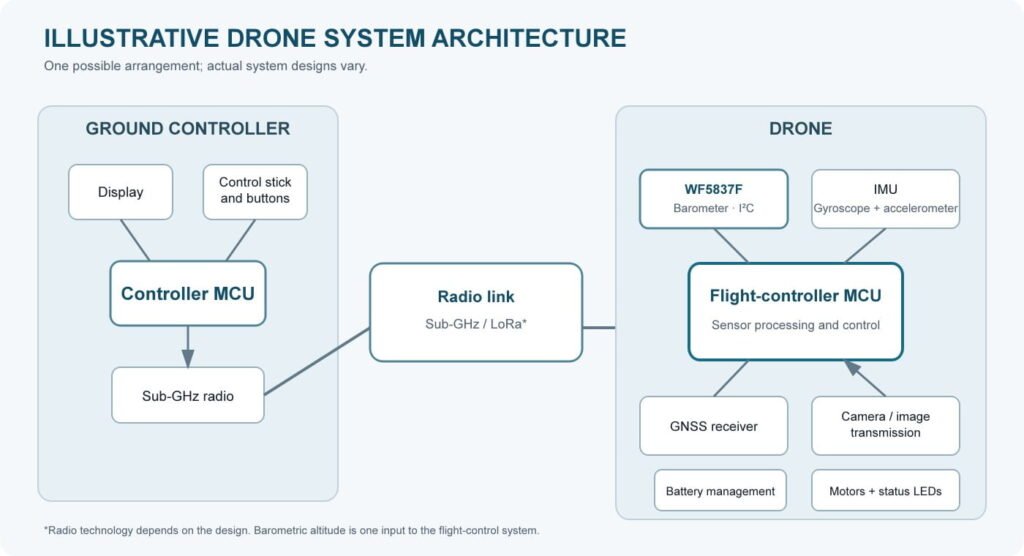
For example, in a UAV system architecture, a digital barometric pressure sensor is typically connected directly to the flight-control MCU through an I2C interface. The resulting altitude data can be fed into the flight-control algorithms in real time.
Using the altitude data provided by the sensor, the system can calculate the rate of altitude change and identify abnormal flight conditions, such as unexpected descent, rapid altitude loss, or unintended climbing. The system can then initiate protective actions or attitude-correction mechanisms.
This ability to detect transient altitude changes with high sensitivity can provide an additional layer of safety and redundancy, helping UAVs maintain stable flight under complex operating conditions.
Kesimpulan
Digital barometric pressure sensors provide a practical and energy-efficient solution for altitude measurement across UAVs, wearable devices, indoor positioning systems, and IoT applications. By accurately measuring atmospheric pressure and applying appropriate compensation and altitude calculation algorithms, these sensors enable real-time altitude estimation in compact, low-power systems.
The WF5837F can be positioned as a potential solution for barometric sensing applications where measurement accuracy, response time, power consumption, and system integration are important considerations. Selecting the right sensor and optimizing its configuration are essential for achieving reliable altitude measurement in real-world operating conditions.
For engineers and product developers, understanding the relationship between pressure resolution and altitude estimation accuracy is a key step toward designing more reliable altitude-sensing systems.
Pengenalan di atas hanya menggaru permukaan aplikasi teknologi sensor tekanan. Kami akan terus meneroka pelbagai jenis elemen sensor yang digunakan dalam pelbagai produk, bagaimana mereka bekerja, dan kelebihan dan kekurangan mereka. Jika anda ingin lebih terperinci mengenai apa yang dibincangkan di sini, anda boleh menyemak kandungan yang berkaitan kemudian dalam panduan ini. Sekiranya anda ditekan untuk masa, anda juga boleh klik di sini untuk memuat turun butiran panduan ini Data PDF Produk Sensor Tekanan Udara.
Untuk maklumat lanjut mengenai teknologi sensor lain, sila Lawati Halaman Sensor kami.