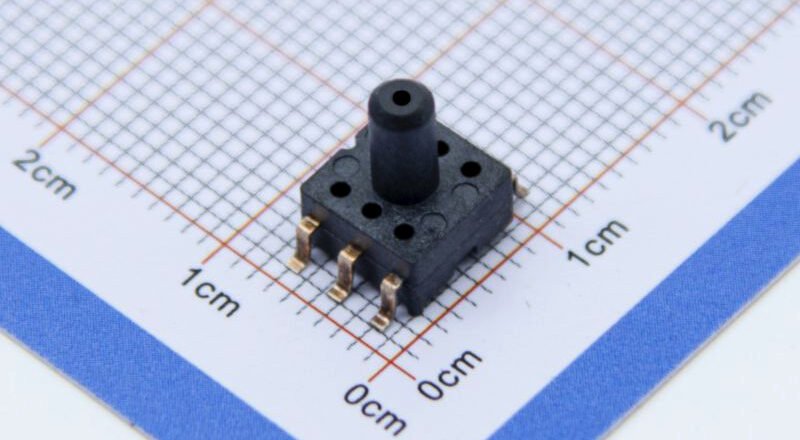
The pressure sensor is the only part of a digital pressure switch that ever touches the process. Display, relay, bus output — they all act on what this one component reports. Here are the five jobs it does inside the switch.
1. Real-Time Pressure Monitoring and Digital Display
The sensor reads gas or liquid pressure inside the line or sealed vessel and turns it into an electrical signal — 4-20 mA, 0-10 V, or plain digital. The display shows the live value at up to ±0.1%FS resolution. No needle, no parallax, no squinting between the tick marks.
One button switches units. kPa, bar, psi, MPa. The plant can keep speaking its own dialect.
2. Threshold Control and Switch Action
Set the trip points from the keypad or from host software. An upper alarm, a lower protection limit, whatever the process needs. The sensor compares the live reading against them and drives the relay or a PLC input — a pump starts, a valve closes, an alarm goes off. That's the switch part of the pressure switch.
Hysteresis is the setting people skip and then regret. Pressure hovering at the threshold makes a naive switch chatter — click, click, click — and chatter burns contacts. Set a deadband, ±5 kPa for example, and the unit trips once at one point and resets at another. Clean action, quiet relay.
3. Adaptive Control and System Protection
Temperature swings and compressible media (gas squeezes, liquid doesn't) skew a raw reading. A temperature-compensation algorithm corrects the measurement in the background, so the control decision stays honest through the shift.
Over-pressure is where the switch earns its keep. A blocked line or a failing pump spikes the circuit; the switch trips, cuts power, latches the state. Equipment stays intact and nobody files an incident report. That single function usually pays for the unit.
4. Data Logging and Remote Interaction
The switch remembers what the line did. Peaks, troughs, the shape of the last fault — pull it over USB or send it wireless to a monitoring platform and last Tuesday stops being a mystery.
And you can drive it from a desk. Modbus, CAN, plus wireless options like LoRa or NB-IoT. Change a threshold remotely, watch live status, collect enough history for predictive maintenance before anything fails.
5. What Makes It Hard
Industrial sites are loud, electrically and mechanically. Differential signaling, shielded cable, and a little digital filtering — a moving average covers most of it — keep the reading stable.
Corrosive media will find your sensor. Hastelloy or ceramic diaphragms handle the chemistry, or put an isolation diaphragm in between and measure indirectly.
Every sensor drifts. The good ones admit it and correct for it — automatic zero calibration, periodic self-checks, coefficients stored in EEPROM. Full-range accuracy holds up over years, not just at first power-on.
Where This Is Going
Machine learning is starting to read pressure trends the way an experienced tech does. Early pump wear leaves a fingerprint in the curve long before it shows up in a work order. Edge computing pushes that analysis into the sensor itself, and MEMS keeps shrinking — the sensing head fits in pipes and corners that used to be impossible.
That's the job. Turn pressure into a number, act on the number, remember what happened. The housing is commodity. The sensing core is the switch.
Frequently Asked
Accuracy or repeatability — which one actually matters?
Accuracy describes how close a reading sits to the true value. Repeatability describes how consistently the switch trips at the same point under the same conditions. One can be good while the other isn't. A safety cutoff lives on repeatability. A calibration reference lives on accuracy.
Why not stay with a mechanical pressure switch?
Mechanical switches work fine until you need a live number, more than one threshold, a trip history, or a setpoint change without a wrench. The sensor is what makes all four possible.
Analog output or digital bus?
Analog (4-20 mA, 0-10 V) when a PLC input just needs the live value. Digital (Modbus, CAN) when you want thresholds, diagnostics, and history sharing the same pair of wires.
Recommended Sensor Models
Recommended pressure sensor models for this application