
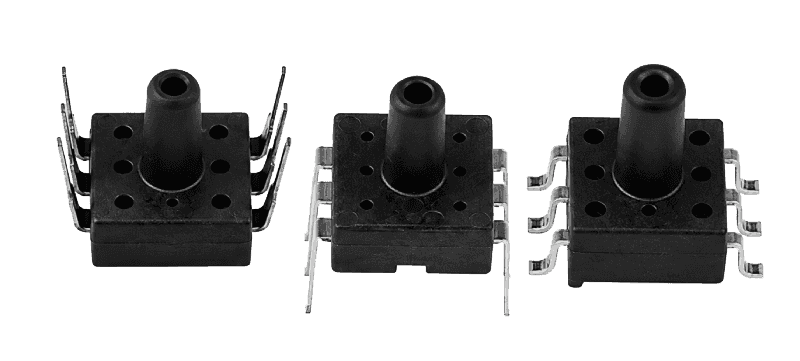
Менш помітний, ніж лідар чи гіроскоп, датчик тиску в роботі-чистарі все ще покращує ефективність прибирання, екологічну обізнаність і захист пристрою в кількох ключових точках.
The role of the pressure sensor in a mopping robot centers mainly on cleaning-performance optimization, environmental awareness, and device protection. Though less prominent than a navigation sensor (lidar, camera) or a motion sensor (gyroscope), precise pressure-data acquisition combined with algorithm fusion can meaningfully improve the robot's intelligence and reliability at several key points. The specific functions are analyzed below:
1. Water-Tank Pressure Monitoring and Water-Output Control
Constant-pressure water supply: in a mopping robot equipped with an electronically controlled water tank, the pressure sensor monitors internal tank pressure in real time and, combined with a micro water pump, regulates water-output flow — increasing output under higher pressure and auto-replenishing at low pressure — to keep the mop pad evenly damp and avoid over-wetting or incomplete cleaning.
Leak protection: the sensor detects an abnormal pressure drop in the tank or piping (such as a loose fitting or a cracked tank) and immediately shuts off the water line and sounds an alarm, preventing a leak from damaging the floor or the robot's internal circuitry.
2. Mop Pressure Sensing and Cleaning-Force Adjustment
Contact-pressure feedback: by detecting pressure changes as the mop-pad bracket contacts the floor (the resistance difference between carpet and hard flooring, for example), the robot dynamically adjusts downward pressure — light pressure on hard floors to reduce noise and wear, and increased pressure on carpet or stubborn stains to improve cleaning effect.
Obstacle-crossing optimization: combining pressure and motion-sensor data, the robot judges whether it has become stuck on a carpet edge or a door threshold, triggering an obstacle-crossing mode such as briefly increasing pressure to lift the body.
3. Seal Detection and Dust-Bin Management
Dust-bin blockage warning: monitoring internal pressure changes in the dust bin — if pressure keeps rising (because dust buildup is blocking the airway) — prompts the user to clean the filter or replace the dust bag.
Airtightness self-check: before startup or a cleaning task, the pressure sensor checks the body's seal integrity — whether the side brush or mop bracket is properly installed — to avoid reduced suction or mopping efficiency from an air leak.
4. Environmental Awareness and Navigation Assistance
Floor recognition: sensing height changes between floors via pressure differential (in a villa or duplex home, for example) helps the robot build a layered map and avoid map confusion when cleaning across multiple floors.
Door/window open-close detection: monitoring minor indoor/outdoor pressure changes — such as airflow disturbance from a door or window suddenly opening — updates the navigation path or pauses the task to prevent the robot from accidentally leaving the cleaning zone.
5. Fault Diagnosis and Maintenance Reminders
Motor-load monitoring: pressure fluctuations while the main brush or roller brush is working indirectly indicate motor-load status. If pressure is abnormal (such as increased resistance from tangled hair), the robot triggers a shutdown-protection and cleaning reminder.
Battery health management: pressure changes in a sealed battery compartment can reflect battery-swelling risk (from overheating or aging), providing an early safety warning.
Технічні виклики та рішення
Micro-pressure detection precision: pressure changes in a mopping scenario are small (mop-contact pressure may be just a few pascals), requiring a high-sensitivity sensor (such as a MEMS barometer) paired with filtering algorithms to eliminate environmental noise like air-conditioning airflow.
Multi-sensor data fusion: pressure data needs to work together with the gyroscope and torque sensor to avoid misjudging a single signal — for example, mistaking a floor dip for a change in mop pressure.
Cost and size constraints: a consumer-grade mopping robot needs to balance sensor performance and cost, typically opting for an integrated module such as a combined pressure + temperature/humidity sensor.
Future Directions
AI-driven dynamic cleaning strategy: training a model on pressure data to identify floor material (tile, wood, short-pile carpet) and automatically match cleaning parameters — pressure, moisture, travel speed.
Adaptive terrain compensation: on a slope or uneven floor, real-time pressure feedback adjusts the center-of-gravity distribution to prevent the body from tilting and creating a cleaning blind spot.
Predictive maintenance: using long-term pressure-data trends to predict component lifespan — a worn water-tank seal or motor wear — and push replacement recommendations in advance.
Висновок
The pressure sensor gives a mopping robot a sense of 'touch' and 'breath.' From micro-level pressure sensing to macro-level environmental adaptation, its role runs through cleaning-performance optimization, device protection, and smart decision-making. Although the application is currently still in a supporting role, as sensor precision improves and AI algorithms deepen, it may become one of the core technical pillars enabling all-terrain adaptive cleaning and zero-intervention maintenance in mopping robots.
The source material's own numbers are worth underlining — a few pascals of mop-contact pressure is genuinely at the edge of what a consumer-grade MEMS barometer resolves cleanly, which is why the filtering-algorithm requirement isn't a footnote here; it's arguably a bigger differentiator between competing designs than the sensor's raw accuracy spec.
Frequently Asked
Why does a mopping robot need pressure sensing instead of just a water-level float switch?
A float switch only reports tank volume; pressure sensing gives continuous flow-rate feedback, which is what keeps mop-pad moisture consistent across a whole cleaning run.