
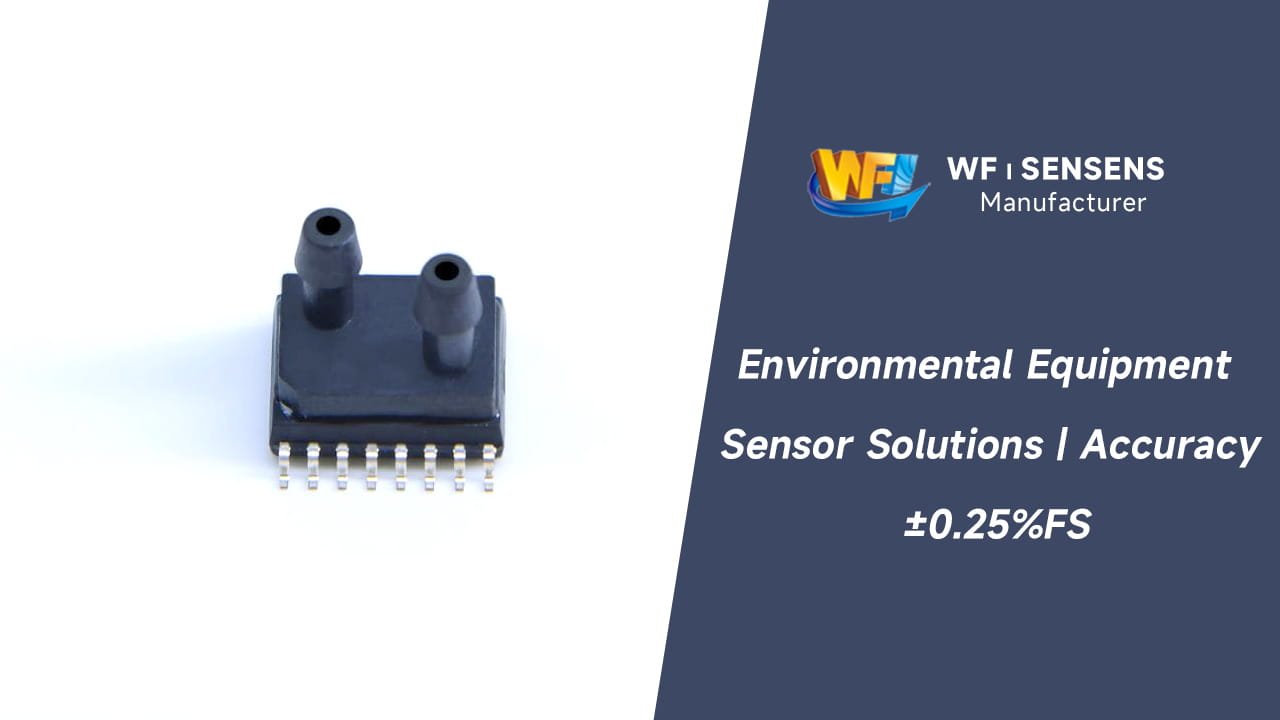
The flue gas parameter monitoring system includes measurements of flue gas velocity, flue gas static pressure, flue gas temperature, and flue gas humidity. The flue gas velocity and flue gas pressure are simultaneously measured using a differential pressure transmitter, and the flue gas velocity is derived by measuring both the total pressure 그리고 static pressure of the flue gas flow. The pressure sensor used for measuring flue gas velocity and flow typically employs a 차압 센서 based on the pitot tube principle, and it is paired with an atmospheric pressure sensor to perform atmospheric data compensation.
목록
The key to flue gas monitoring: static and dynamic pressure
In flue gas monitoring systems, flue gas flow rate and pressure measurements are usually performed using differential pressure sensors. Two basic concepts are involved here:
- Static pressure (P): the actual pressure in the flowing flue gas, a value measured by the Pitot tube static pressure orifice.
- Total pressure (P₀): the pressure when the flow rate drops to zero, a value captured by the Pitot tube total pressure orifice.
The difference between the two is the dynamic pressure, which is the basis for revealing the mysteries of fluid mechanics through Bernoulli’s equation:
- The difference between the total pressure and the static pressure, i.e. the dynamic pressure, is proportional to the square of the flue gas flow rate.
This set of principles provides the theoretical basis for the actual measurement of flue gas flow rates and is the first step in our understanding of sensor selection.
Differential pressure sensors and the Pitot tube principle
Measurement of flue gas flow rates often relies on the Pitot tube principle. This is done by:
- The total and static pressure data are measured using a Pitot tube;
- Differential pressure sensors capture the difference between the two in real time;
- Compensation by an air pressure sensor ensures that the data is not distorted by environmental changes.
This combination ensures that in practice, no matter how complex the environment is, highly accurate monitoring can be achieved.
Shenzhen Weifengheng Technology Two Solutions for WFsensors
Shenzhen Weifengheng Technology has launched two solutions for flue gas flow monitoring, each with its own characteristics:

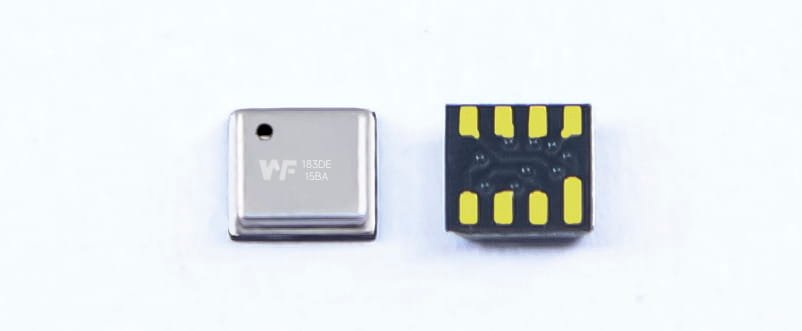
1. Differential Pressure Flow Measurement - WF200D Series
- Pressure range: ±50 cmH₂O / ±1.45 psi / ±10 KPa
- 작동 온도: -40°C to 125°C
- 공급 전압: 1.8-3.6V, mv/IIC output supported
- 선형성: ±0.5%FS
- Total Error Band (TEB): ±1%FS
Size: 10.3 x 10.3 x 10.3 mm - 특징: High stability, high accuracy, compatible with SM9541
The WF200D series uses a precision differential pressure sensor to measure the full and static flue gas pressure by means of a Pitot tube to accurately calculate the flue gas flow rate, making it suitable for industrial flue gas monitoring scenarios where stability is required.
2. Differential Pressure Flow Sensor - WF4525 Series
- Pressure range: ±160 Pa to ±1 MPa
- 작동 온도: -40°C to 125°C
- Output: SPI/IIC, 14bit digital signal
- 정확성: ± 0.25% fs
- Total Error Band (TEB): ±1%FS
- Dimensions: 12.5 x 9.9 mm
- 특징: High stability, high reliability, high accuracy, compatible with TE4515/4525
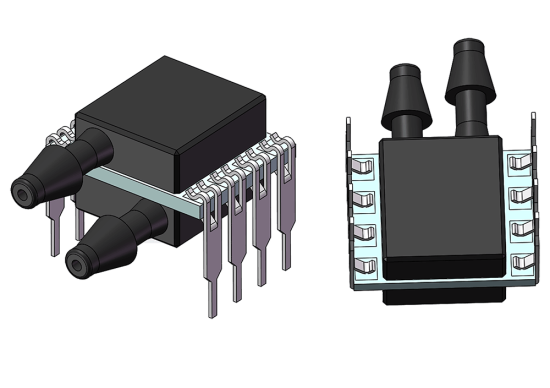
The WF4525 series is even more outstanding in terms of accuracy, with an accuracy of up to ±0.25%FSS, making it ideal for environmentally friendly equipment with stringent measurement requirements, ensuring reliable data is available even in extreme environments.
Why is accuracy and stability critical?
In environmental monitoring systems, data accuracy is directly related to subsequent decision-making and equipment operation:
- Data-driven decision-making: Accurate flue gas flow rate and pressure data help environmental protection departments detect abnormalities and take countermeasures in a timely manner.
- Equipment Reliability: High-precision sensors reduce errors and equipment loss, extending system life and reducing maintenance costs.
- Environmental adaptability: Through atmospheric pressure compensation, the system is able to adapt to different environmental pressure changes, ensuring stable data.
- Reduced maintenance costs: High-precision sensors reduce the accumulation of errors and extend the life of the equipment, thus reducing long-term maintenance and replacement costs.
최종 생각: 올바른 센서는 시간과 비용을 절약해 줍니다.
Choosing the right sensor solution for environmental equipment is not just about selecting one sensor, but about seamlessly integrating sensor technology with specific 응용 프로그램 시나리오. Whether you choose the high-stability WF200D series or the ultra-high precision WF4525 시리즈, the key is to make an informed decision based on your actual monitoring needs. By leveraging pitot tube 그리고 differential pressure technology, even in extreme environments, accurate flue gas monitoring can be achieved, providing solid data support for environmental protection.
위의 소개는 압력 센서 기술 적용의 표면적인 부분에 불과합니다. 우리는 다양한 제품에 사용되는 다양한 유형의 센서 요소, 작동 방식, 장점과 단점을 계속해서 탐구할 것입니다. 여기에서 논의된 내용에 대해 더 자세히 알아보려면 이 가이드 뒷부분의 관련 콘텐츠를 확인하세요. 시간이 촉박한 경우 여기를 클릭하여 이 가이드의 세부정보를 다운로드할 수도 있습니다. 공기 압력 센서 제품 PDF 데이터.
다른 센서 기술에 대한 자세한 내용은 다음을 참조하십시오. 센서 페이지를 방문하십시오.

-e1747998312687.jpg)