

Washing machine water level sensors are a small component with an outsized job: get the reading wrong by even a few millimeters and you end up with under-filled loads, overflow, or a motor straining against an unbalanced drum. This guide covers how these sensors actually work, how to find and diagnose one in a household machine, and — for engineers and OEMs sourcing a component for a new design — how to select the right MEMS pressure sensor for the job.
Whether you're a technician troubleshooting a machine that won't stop filling, or an engineer specifying a sensor for a new appliance platform, jump to the section that applies to you using the contents below.
What Is a Washing Machine Water Level Sensor?
A washing machine water level sensor is the component that tells the control board how much water is in the tub, so the machine knows when to stop filling, when it's safe to start heating, and when it's safe to spin. Without an accurate reading, a machine can overfill, waste water and energy, or damage clothing by spinning with an insufficient or unbalanced water load.
Several sensing technologies have been used over the decades:
| Method | How it works | Precisione | Common in |
|---|---|---|---|
| Float switch | A mechanical float rises with water and trips a switch at a fixed point | Low — a few discrete levels only | Older/budget machines |
| Reed switch + magnet | A magnet on a float actuates a sealed reed switch | Low–Medium | Older top-load machines |
| Ultrasonic reflection | Measures time-of-flight of a sound pulse off the water surface | Medium — affected by foam/turbulence | Some premium models |
| Resistive/capacitive probe | Electrodes sense a conductivity or capacitance change in contact with water | Medium — prone to fouling from detergent/mineral buildup | Some mid-range machines |
| MEMS air-pressure sensor | Diaphragm senses air pressure change caused by rising water in a sealed chamber | High — millimeter-level, continuous | Most modern front-load and drum machines |
Most washing machines built in the last 10–15 years use the MEMS pressure sensor method, because it never contacts the water directly — it senses pressure through a sealed air tube — which makes it far more resistant to the corrosion, mineral scaling, and detergent fouling that shorten the life of contact-based sensors.

How the Water Level Sensor Works
- Sealed air chamber. The outer drum of the washing machine has a small air chamber built into its base. This chamber connects — via a length of plastic tubing — to the sensor itself, which is usually mounted near the water inlet valve or behind the control panel.
- Water rises, pressure rises. As water fills the drum, it compresses the air trapped in the chamber and tubing. That rising air pressure pushes against a diaphragm inside the sensor.
- Diaphragm movement generates a signal. In classic mechanical-electric designs, the diaphragm moves a coil within a magnetic ring, changing the coil's inductance in an LC circuit — more water pressure means more diaphragm deflection means a larger inductance change. In modern designs, this same air-pressure input is read by a MEMS pressure sensor, which converts the pressure directly into an analog voltage or a digital (I2C/SPI) signal — a more stable, drift-resistant, and precise approach than the older inductive coil method.
- The control board reads the signal. The washing machine's computer board compares the sensor's output against the target water level for the selected wash cycle.
- Closed-loop water control. Based on the difference between actual and target level, the control board opens or closes the inlet solenoid valve. On machines with a heating cycle, the heating element is only activated once a safe water level is confirmed — this is also a safety interlock that prevents the heater from running dry.
- Applications beyond washing machines. The same air-pressure sensing principle is used well beyond household appliances — in water treatment plants, storage tanks, wells, and industrial liquid-level monitoring systems — anywhere a non-contact, corrosion-resistant level measurement is needed.

Where Is the Water Level Sensor Located?
The exact location depends on the machine type:
- Front-load / drum washing machines: Open the top cover and follow the water inlet pipe from the inlet valve. The sensor is typically mounted right next to the inlet valve, connected to a length of clear or colored plastic tubing.
- Top-load / wave-action washing machines: The sensor is usually mounted behind the control panel, below the water level selector knob. You'll need to remove the control panel to access it.
- In both cases, trace the tubing: one end connects to the sensor, the other end connects to the air chamber built into the base of the outer drum.

Common Faults and Symptoms
A failing water level sensor tends to produce one of these recognizable symptoms:
| Symptom | Likely Cause |
|---|---|
| Machine keeps filling and won't stop | Sensor isn't reporting the rising water level to the control board, so it never receives the "stop fill" signal |
| Machine won't fill at all | Sensor may be stuck reporting a "full" reading, or the air tube is disconnected/blocked |
| No spin cycle | Many control boards block spin if the water level reading doesn't match the expected drained state, as a safety measure |
| Laundry comes out not properly clean | Incorrect water level readings can cause the machine to under- or over-fill relative to the load, affecting wash performance |
| Water/electricity usage noticeably higher than normal | The actual fill level drifts from the selected setting, so the machine compensates by cycling the inlet valve repeatedly |
If you notice these symptoms, the two most common root causes — in order of likelihood — are: (1) a kinked, disconnected, or blocked air tube (check this first, it's the easiest fix), and (2) a failed sensor diaphragm or internal circuit, which typically requires replacement rather than repair.
How to Test a Water Level Sensor
- Unplug the machine and locate the sensor as described above.
- Inspect the air tube for kinks, cracks, or disconnection at either end. A surprising number of "sensor failures" are actually just a dislodged or pinched tube.
- Blow gently into the disconnected tube (with the sensor end still connected) — on a working mechanical-inductive sensor, you should hear or feel a faint click or resistance change as the diaphragm moves. No response usually indicates a failed diaphragm.
- Check for visible corrosion or moisture inside the sensor housing, which indicates water ingress and confirms the unit needs replacement.
- If the machine has a diagnostic/service mode (check your model's manual), many boards can display the live sensor reading, which you can compare against actual water level as the machine fills — the most reliable test if available.
If testing confirms a failed sensor, replacement is generally more practical than repair, since the sensor is a low-cost, sealed component not designed to be opened.
Engineering Guide: Selecting a MEMS Pressure Sensor for Water Level Detection
If you're specifying a water level sensing solution for a new washing machine platform (or any similar white-goods application — dishwashers, water purifiers, boilers), the selection criteria below are what actually determine fit for mass production.
1. Pressure range
Washing machine water columns typically correspond to low differential pressures — most designs fall in the 0–100 kPa range, depending on drum depth and tube routing, though platforms with deeper tubs or dual-chamber designs may spec higher. Oversizing the range reduces resolution exactly where accuracy matters most — early-cycle fill detection. Undersizing risks overpressure damage from foam surges or a kinked tube.
2. Output interface: analog vs. digital
| Analog (mV output) | Digital (I2C/SPI) | |
|---|---|---|
| Integrazione | Requires an external ADC on the MCU side | Direct digital read, no external ADC needed |
| Immunità al rumore | More susceptible to EMI on long wiring runs near motors/heaters | Better noise immunity, easier to route near noisy loads |
| Calibrazione | Often needs self-calibration compensation. | Typically ships factory-calibrated with onboard compensation |
| Best fit | Cost-sensitive boards with a spare ADC channel | Platforms already using I2C/SPI peripherals, or where BOM favors fewer external components |
3. Accuracy across temperature
Wash cycles run from cold fill through heated wash, so the sensor must hold stable output across a realistic operating range — not just at room temperature. Check the datasheet's total error band (TEB) across temperature, which is a better predictor of real-world performance than a single room-temperature accuracy figure.
4. Package and mounting
Control panel and inlet-valve areas are tight on space. Compact SOP or LGA packages that reflow-solder directly to the control PCB, with a port designed for direct tube connection, are the standard for this application.
5. Media compatibility and sealing
Even in a non-contact design, humidity and detergent vapor reach the mounting area over years of service. Confirm IP-rated sealing and RoHS/REACH compliance against the datasheet and test reports rather than assuming — this matters for field reliability and for meeting your target market's compliance requirements.
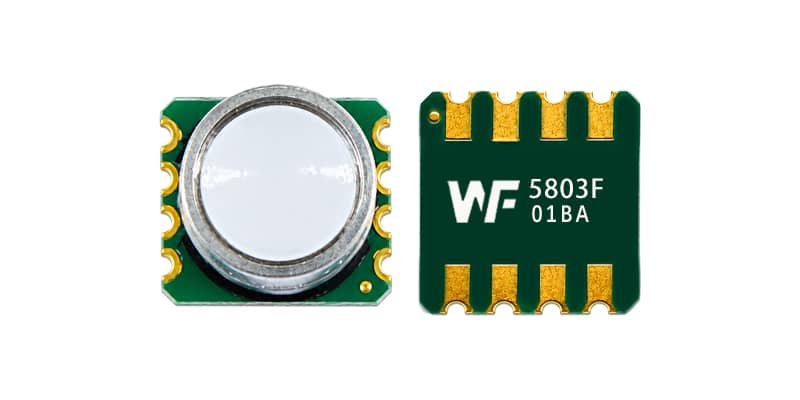
Recommended starting points
| Modello | Intervallo di pressione | Output | Pacchetto | Typical Use |
|---|---|---|---|---|
| WF100DPZ-1BG-S6-DT | 0–100 kPa (custom lower ranges available) | I2C/SPI digital | SOP6 | Digital control boards needing calibrated, drift-stable output |
| WF5803F-01BA-L8-DT | 0–100 kPa (1 Bar absolute) | I2C/SPI digital | LGA8 | Compact board layouts, absolute pressure reference designs |
Both are available with custom pressure range calibration for lower-range applications typical of washing machine water columns — worth raising directly with applications engineering, since stock ranges are often tuned by default for other markets (industrial, medical).
FAQ
Where exactly is the water level sensor on my washing machine?
On front-load machines, it's typically mounted near the inlet valve behind the top cover. On top-load/wave-action machines, it's usually behind the control panel below the water level knob. In both cases, follow the plastic air tube to locate it.
Why does my washing machine keep filling and never stop?
This is the most common symptom of a failed or disconnected water level sensor — the control board isn't receiving the signal to close the inlet valve. Check the air tube for kinks or disconnection first before assuming the sensor itself has failed.
Can I fix a water level sensor myself, or does it need replacing?
The sensor is a sealed component — if the diaphragm or internal circuit has failed, it needs to be replaced rather than repaired. Always unplug the machine before inspecting or replacing it, and consult a qualified technician if you're not confident working with the internal wiring.
What pressure range should I specify for a new washing machine design?
Most front-load designs fall between 0–100 kPa, but the correct range depends on drum geometry and tube routing. Confirm with application engineering rather than assuming a standard figure — a mismatched range directly affects low-end resolution.
Do MEMS water level sensors require field calibration after installation?
Digital I2C/SPI variants typically ship factory-calibrated with temperature compensation built in. Analog variants generally require calibration/compensation to be handled on the control board.
Is custom pressure range calibration available for prototype or low-volume runs?
Yes — custom ranges and output scaling are available for both prototype and production volumes. Contact our applications team with your target range and expected volume for a quote.


