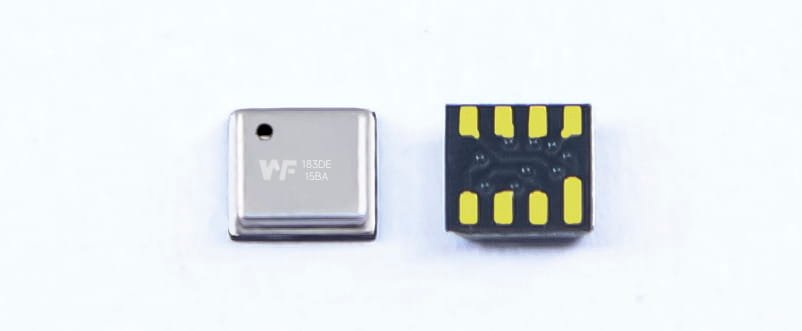
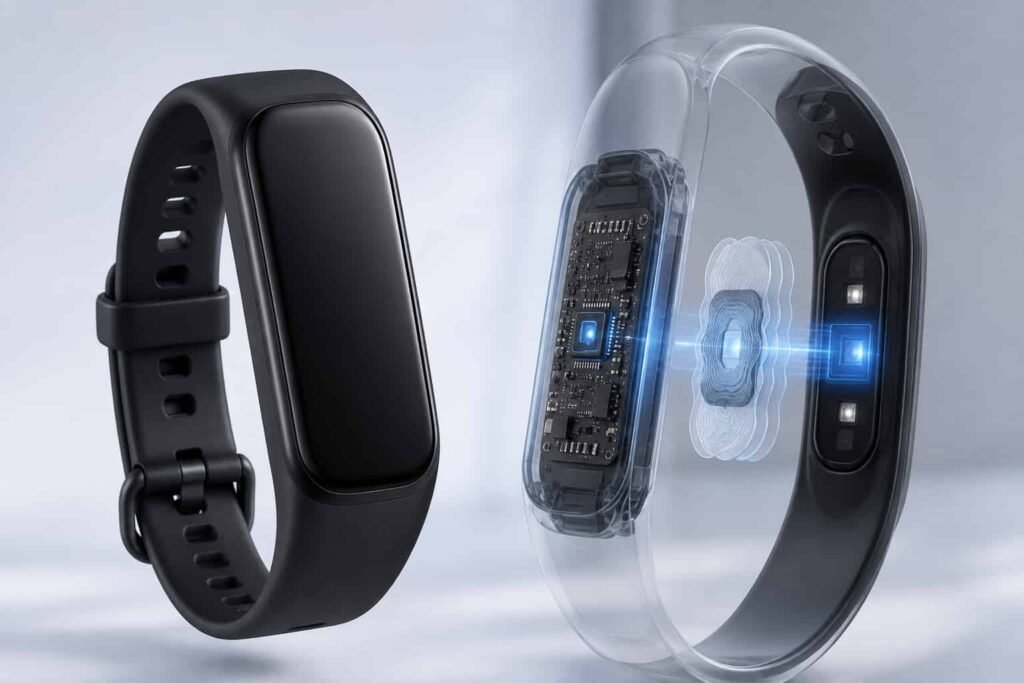
ʻO ka ʻike paʻi, i loko o kahi pūʻali akamai.
Less prominent than in an outdoor watch, the barometric sensor in a smart band still adds real value — in altitude awareness, exercise tracking, health monitoring, and experience optimization.
The role of a pressure sensor in a smart fitness band is not as pronounced as it is in a professional outdoor watch or an underwater device, but its function still centers on environmental awareness, exercise and health monitoring, and user-experience optimization. Although the band's size and power constraints keep the application relatively streamlined, data fusion and algorithm optimization still let it deliver the following core value.
Basic environmental awareness and exercise assistance
Altitude estimation
Real-time pressure data is used to estimate current altitude (requiring GPS or manual calibration of a starting elevation) — useful for mountaineering and hiking, helping the user understand vertical movement such as cumulative climb.
Weather-trend reminders
Monitoring the pressure-change trend (a sharp drop can suggest incoming rain or a storm) provides a simple weather warning — though this requires algorithmic noise filtering, and accuracy is lower than a professional weather device.
Exercise mode optimization
Vertical motion tracking
In running or stair climbing, combining accelerometer data with pressure changes identifies rise and fall in elevation, for a more precise calorie and intensity calculation.
Terrain adaptation analysis
Recording the elevation profile of an outdoor run or ride generates a terrain profile that helps the user optimize training plans, such as altitude-adaptation training.
Potential applications in health monitoring
Breathing-rate monitoring (experimental)
A high-precision pressure sensor can pick up the tiny pressure fluctuations at the wrist caused by breathing (requiring close skin contact) to indirectly estimate breathing rate, as a supplement to heart-rate and blood-oxygen data.
Altitude-sickness warning
At high altitude, pressure data estimates current elevation and — combined with blood-oxygen-saturation monitoring — alerts the user to the risk of oxygen deficiency.
Smart scene linkage
Automatic exercise-mode switching
When the band detects a sustained pressure drop (suggesting the wearer has moved indoors or into an elevator), it pauses outdoor exercise recording and switches to an indoor mode — for example, converting stair-climb counting into step counting.
Environmental-adaptation reminders
Based on pressure and temperature data, the band can suggest the user adjust exercise intensity, such as reducing vigorous activity in a low-pressure environment.
Technical challenges and solutions
Balancing consumption and battery life
The pressure sensor needs to stay on standby long-term; dynamic sampling — high-frequency acquisition only when exercise mode is active — reduces power draw and extends battery life.
Precision under real-world conditions
How snugly the band is worn and body-temperature interference with local pressure both need algorithmic compensation, such as correction referenced against temperature-sensor data.
Filtering environmental noise
Pressure readings are easily disturbed by the environment (strong wind, indoor air-conditioning airflow), requiring fusion with accelerometer and GPS data to filter out anomalies.
Future directions
Miniaturized integration
Developing ultra-low-power, miniature pressure-sensor modules suited to the band's compact design.
AI-driven environmental awareness
Combining pressure, temperature, and humidity data to train a model that predicts the user's activity scenario — mountaineering, diving, indoor fitness.
Expanded health research
Exploring the potential link between pressure changes and sleep quality (snoring monitoring, for instance) or cardiovascular health, to provide personalized recommendations.
Hopena
The pressure sensor adds vertical-space awareness and environmental adaptability to a smart band. Though not a core functional module, it can meaningfully improve outdoor exercise-tracking accuracy and the scope of health monitoring. As technology optimization and multi-sensor fusion advance, its role is expected to shift from a nice-to-have to a precisely-empowering feature — with particular promise in emerging areas like altitude health management and breathing monitoring. As sensor cost falls and algorithms improve, barometric functionality may become one of the differentiating features of mid-to-high-end smart bands.
The power-budget trade-off flagged above is the real gating factor for this category — a band that samples pressure continuously the way a dedicated outdoor watch does will simply not hit multi-day battery-life targets, so the dynamic-sampling strategy described in the source material isn't optional polish, it's the core design decision.
Frequently asked
Does adding a pressure sensor noticeably shorten battery life on a fitness band?
Not when duty-cycled correctly — a well-tuned low-power design typically adds only a small fraction of daily current draw compared to the display and Bluetooth radio.