
Catalóg
Water-meter hydraulics demand sensors that keep stable readings under liquid media, flow pulsation, and temperature shifts. A media-isolated design—metal diaphragm (stainless steel, titanium, or nickel alloy) + oil-filled cavity + silicon strain gauge—provides robust isolation. Choosing the right material, process connection, and output protocol, together with compensation and signal conditioning, improves reading consistency and eases system integration.
1. Key design decisions and material impact
Material choice sets long-term reliability in water meters. Stainless steel, titanium or nickel alloys give corrosion resistance and strength. Diaphragm size and connection control sensitivity and sealing.
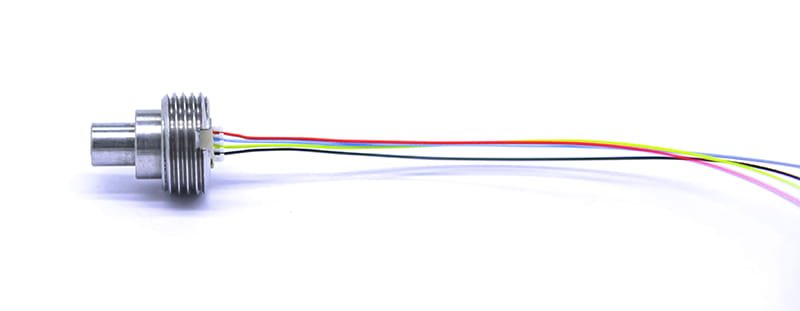
2. Isolation and force transfer: principle and common distortion sources
Metal diaphragm transmits water pressure into an oil-filled cavity that passes force to the silicon strain gauge. Proper oil selection and vacuum de-bubbling prevent bubbles and reduce nonlinearity and measurement drift.
3. Amplification, ratiometric output and digital protocols’ role in stability
Stable output needs mechanical isolation and robust electronics. Amplification or ratiometric outputs raise bridge signals; digital I2C/SPI reduces noise and keeps calibration for linearization and traceability.
4. Temperature effects, compensation methods and validation steps
Temperature causes zero drift and sensitivity change. Match materials, use internal temperature sensing, and store multi-point compensation curves. Validate with temperature cycling, thermal shock and humidity tests.
5. Installation practice, mechanical isolation and lifetime verification points
Installation must avoid torque and radial stress. Use torque limiters, flush or welded mounts, and flexible adapters to protect the sensor. Verify with pressure cycling, vibration, shock and long-term zero-drift tests.
Summary points
Material and diaphragm design determine long-term stability and corrosion resistance.
Vacuum de-bubbling and proper oil filling are essential to prevent drift.
Internal amplification, ratiometric outputs or digital I2C/SPI reduce system noise and improve integration.
Multi-point temperature calibration with onboard compensation maintains consistent readings.
Correct installation and full reliability testing prevent field-induced reading errors.
Conclúid
For water-meter hydraulics, media-isolated pressure sensors deliver stable, repeatable outputs when engineered with the right materials, robust isolation and filling methods, careful signal conditioning, and strict temperature and installation controls. Integrating these practices with factory calibration and traceable tests improves metering accuracy and lowers maintenance needs.
Ní dhéanann an réamhrá thuas ach scratches ar dhromchla iarratais na teicneolaíochta braite brú. Leanfaimid orainn ag iniúchadh na gcineálacha éagsúla eilimintí braite a úsáidtear i dtáirgí éagsúla, conas a oibríonn siad, agus a gcuid buntáistí agus míbhuntáistí. Más mian leat tuilleadh sonraí a fháil ar a bhfuil pléite anseo, is féidir leat an t-ábhar gaolmhar a sheiceáil níos déanaí sa treoir seo. Má tá brú ama ort, is féidir leat cliceáil anseo freisin chun sonraí na dtreoracha seo a íoslódáil Sonraí PDF Táirge Braiteora Aeir Brú Aeir.
Le haghaidh tuilleadh eolais ar theicneolaíochtaí braiteora eile, le do thoil Tabhair cuairt ar ár leathanach braiteoirí.