
Gauge Pressure Temperature Compensated Sensor
Gauge-type temperature compensated pressure sensor is a sensor module that measures pressure values using ambient atmospheric pressure as a reference zero point and automatically corrects for measurement deviations caused by temperature changes through a built-in temperature compensation mechanism. Ordinary pressure sensors experience reading drift when temperatures fluctuate; however, with temperature compensation, they maintain stable accuracy within the calibrated temperature compensation range (e.g., 0~70°C).

WF100E-P
Positive Pressure
Pressure Range: 0kPa to 1200 kPa (select)
Supply Voltage: 0.5~4.5V
Operating Temperature: -40 to 125℃
Size: 10×8.5×9 mm
Package: DIP-6/SOP-6
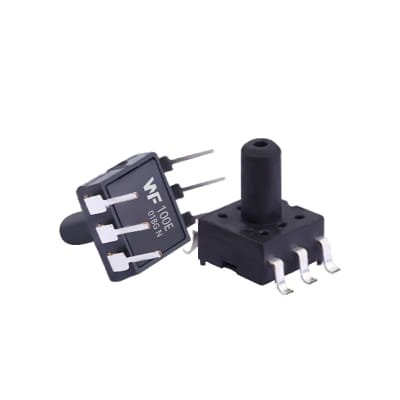
WF100E-N
Vacuum Type
Pressure Range: -100kPa to 0 kPa (select)
Supply Voltage: 0.2~4.7V
Operating Temperature: -40 to 125℃
Size: 10×8.5×9 mm
Package: DIP-6/SOP-6

WF100E-W
Positive and Negative Pressure
Pressure Range: -100kPa to 1000 kPa (select)
Supply Voltage: 0.5~4.5V
Operating Temperature: -40 to 125℃
Size: 10×8.5×9 mm
Package: DIP-6/SOP-6
ФАК
Measurement Types
The most common measurement types for pressure sensors include absolute pressure, gauge pressure, sealed gauge pressure, differential pressure, and combined pressure.
Absolute:
Measures pressure relative to a hard vacuum. Typically, these devices contain a small vacuum chamber exposed on one side of the sensor, and the pressure to be measured is applied to the other side. At sea level, an absolute pressure sensor exposed to air will read 1 ATM or 14.7 psi.
Манометарски притисак:
Measures pressure relative to local atmospheric pressure. One side of the sensor is exposed to the atmosphere (through a small hole in the housing), and the other side is exposed to the pressure to be measured. A gauge pressure sensor exposed to air will always read zero ATM or zero psi because the same pressure is applied to both sides of the sensor. This device must have a ventilation path to allow some atmosphere into the body.
Sealed Gauge Pressure:
Measures pressure relative to a standard gauge pressure; there is no actual atmospheric reference. Typically, this device includes an absolute reference and electronically adds an offset to represent standard atmospheric pressure. This simulates instrument components that do not require an exhaust path and is typically used in high-pressure environments where atmospheric changes are less significant.
Диференцијални притисак:
This device has two pressure ports and measures the difference between them. This can be used to measure small pressure differentials under high-pressure line pressures, such as filter monitoring. Adding a second port and considering line pressure would result in a large number of scenarios having to be considered when designating the device.
Combined:
Measures both negative and positive gauge pressure. The combined pressure sensor provides a linear output signal from full vacuum to zero pressure and then to full-scale pressure.
Output Signal
Generally, the electrical output of a pressure sensor changes linearly with the applied pressure. Common output types include:
mV:
Typically, the mV signal comes directly from the sensor bridge, requiring only simple calibration electronics. The output will be proportional (ratio) to the supply voltage. The supply can be constant current or constant voltage. The commonly used simple passive compensation circuitry limits accuracy to some extent.
0.5 to 4.5V Ratio:
This is common in automotive applications. The device is powered by a nominal 5V supply, and the output varies proportionally to the supply voltage within a specified range. Some diagnostic codes can be provided by controlling the output outside the range.
Amplified 1-5V:
A variety of amplified signals can be provided, the most common being 1-5V. These devices typically include a voltage regulator, so the output does not vary with the supply voltage.
4-20mA:
A common industry standard, requiring only two wires, its advantage is that the signal is not degraded by long wiring. The device draws 4mA at low voltage and 20mA at full scale. This can be monitored by measuring the voltage across a series resistor.
Digital:
It can provide a variety of digital outputs, including CANBUS, I2C and SPI, URAT, OWI.