- Би ВФсенсорс
ODR and response time are not just two figures in the datasheet: they tell you how fast you can see pressure changes. On the sensor, ODR ties into bandwidth, filtering, ADC conversion rate, noise and power draw. A high refresh rate improves time resolution, but may increase noise and power consumption. From an engineering perspective, this article breaks those links down step by step so you can match a high-refresh-rate pressure sensor to the system and tasks at hand.
Каталог
1. Main expressions and meanings
| Parameter name | Common units | Meaning | Applicable to |
|---|---|---|---|
| Брзина излазних података | Hz (hertz), SPS (samples per second) | How many times per second the sensor outputs data externally (for example, to a controller). This is the most direct and commonly used metric — e.g. 100 Hz means 100 pressure readings per second. | Digital-output sensors (I2C, SPI, other digital interfaces) |
| Sampling rate / Bandwidth | Hz (hertz) | How many raw signals the sensor’s internal signal chain can sample and process per second. ODR is usually ≤ sampling rate; it determines how fast pressure changes can be captured. | Analog and digital sensors |
| Response time | ms (milliseconds), s (seconds) | Time required for the sensor reading to move from its initial value to the final steady value (for example, 90% or 63.2% of the step). It reflects the sensor’s tracking speed for step changes. | All sensor types — especially used in process control |
| Rise time | ms (milliseconds) | Time for the reading to rise from a low value (e.g. 10%) to a high value (e.g. 90%). It is a more specific expression of response time. | All sensor types |
Engineering meaning of ODR and response time
In practice, ODR sets the shortest event interval you can resolve; response time shows how well the device follows a step. If you need to capture sub-millisecond shocks, you must pick a sensor that supports the required ODR and whose internal filtering doesn’t smear the event. Getting the difference between these two specs clear is the first step in system design.

2. Why refresh rate matters
Refresh rate directly decides which applications a sensor can serve. For fast dynamic processes — say combustion chamber pressure, hydraulic shock testing, explosive pressure measurement, or aero engine testing — you often need ODRs above 1 kHz, because pressure changes occur on millisecond or microsecond scales; a slow sensor will simply miss these events. For mid-speed control loops (compressors, pumps, pneumatic control, medical ventilators), tens to hundreds of Hz are usually enough for closed-loop control. For static or slowly changing measurements (liquid level, weather station atmospheric pressure, tank monitoring), <10 Hz is adequate — higher rates only add redundant data and increase power and processing load.
Time-resolution needs across scenarios
When designing, ask: what is the shortest duration of the pressure event I must see? And how fast must the controller act? The answers map directly to required ODR and the downstream data-handling burden.
3. Key factors and trade-offs
Refresh rate isn’t independent — it’s linked to resolution, noise, power and signal bandwidth. Many MEMS digital sensors use a Σ-Δ ADC: in high-speed modes conversion time shortens and noise rises, which looks like lower resolution. According to Nyquist, the sampling rate (ODR) must be at least twice the highest frequency component of the pressure signal. Sensors typically provide digital filters; cutoff is often set to half or a quarter of ODR to reject high-frequency noise. Power consumption climbs as refresh rate increases, so battery-powered IoT or portable devices must balance performance and lifetime.
Σ-Δ ADC, resolution and noise spectral density
With high-resolution sensors, Σ-Δ ADCs and oversampling plus digital filtering give low noise at low ODR. But when you push ODR up, oversampling benefits shrink and the noise spectral density becomes dominant for measurement uncertainty.
4. How to choose refresh rate in a real system
First, quantify the fastest pressure change frequency in your application. Second, read the sensor datasheet for ODR/response time, and see whether the sensor allows configuration between “high speed” and “high accuracy” modes — check how noise, accuracy and power vary with ODR. Third, ensure your MCU and communication bus (I2C, SPI, CAN etc.) can handle the data stream: a 1 kHz sensor produces 1000 samples per second, and if each reading carries extra metadata (temp compensation, checksum), throughput increases. Finally, pick the lowest ODR that meets performance to save power.
System matching and bus throughput
At high refresh rates, SPI usually outperforms I2C because I2C can become the bottleneck with large, frequent packets. Don’t forget to validate post-sampling processing and storage capacity.
5. Advanced configuration and verification
Sensors commonly offer configurable digital filters, averaging and high-precision modes. In practice, start with a lower ODR to gather baseline data, then raise ODR while watching the noise spectrum change. Use a known frequency pressure pulse source or shock rig for time-domain validation: check that pulse shape and amplitude are reproduced at your chosen ODR. Temperature drift can vary with sampling mode, so perform full calibration across operating temperatures and record results. Make sure calibration and temperature compensation methods are documented and applied.
Digital filtering and cutoff frequency settings
Reasonable filtering reduces instantaneous noise but adds phase delay. Engineering practice is to either compensate delays in the system or choose a filter depth the control loop can tolerate.
6. Looking at sensor models: high-refresh-rate pressure sensors
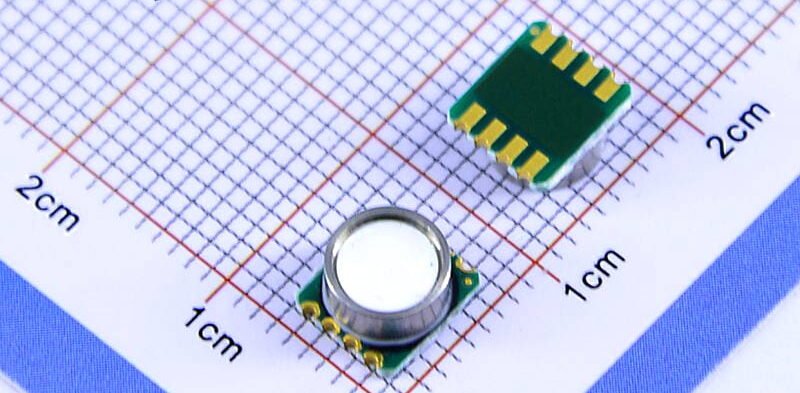
Typical high-refresh-rate pressure sensors pair a silicon MEMS sensing element with an ASIC signal chain. Modern parts use 24-bit Σ-Δ ADCs and provide digital outputs with ESD protection, fast response, good linearity and long-term stability. System-level packages often include temperature compensation and factory calibration, outputting digital pressure readings ready for embedded systems. Packaging and lead layout affect mechanical resonance and parasitic cavities; mounting and fluid coupling require attention.
Packaging and signal integrity
The package’s thermal path affects temperature response speed; long-term stability depends on stress control and soldering quality. When selecting a device, don’t just look at ODR — consider how the package impacts real-world performance.
7. Practical selection flow and engineer’s checklist
Engineer’s steps for ODR selection:
1) quantify shortest event frequency and required control latency;
2) pick sensors whose noise and accuracy at that ODR meet your spec;
3) confirm communication interface and MCU can handle throughput and timing;
4) perform prototype time-domain validation with known pulses;
5) verify temperature dependence and long-term drift, and document calibration coefficients. Only then proceed to production.
Закључак
The data refresh rate of a pressure sensor is the core of its time-resolution capability. Choosing the right ODR involves trade-offs between real-time performance, measurement accuracy, and power. Start from the shortest event duration you need to detect, consult the datasheet for ODR and response time, and ensure the whole signal chain (sensor, bus, MCU, software) is matched. Validate with pulse testing and thermal tests so the datasheet numbers translate into dependable field performance. A high-refresh-rate pressure sensor can capture critical detail — but only if configured and verified correctly.
Горњи увод само загреба површину примене технологије сензора притиска. Наставићемо да истражујемо различите типове сензорских елемената који се користе у различитим производима, како функционишу и њихове предности и недостатке. Ако желите више детаља о томе о чему се овде расправља, можете погледати сродни садржај касније у овом водичу. Ако сте у стисци са временом, такође можете кликнути овде да преузмете детаље овог водича Подаци о сензору притиска ваздуха ПДФ.
За више информација о другим сензорским технологијама, молимо Посетите нашу страницу сензора.