- Por Sensores WF
High-performance pressure sensors give drones sharper altitude and airspeed data with low-noise, fast response, and configurable ranges. Integrated, low-power modules reduce board complexity and improve control loop stability—delivering reliable, testable gains in flight accuracy.
Catálogo
1. Pressure sensing basics for drone accuracy
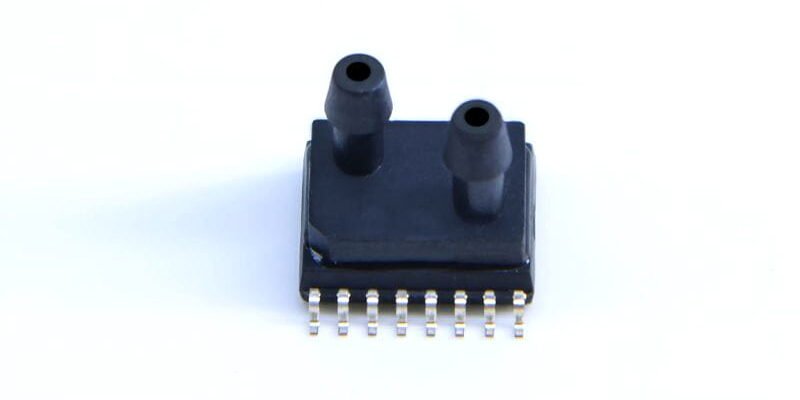
A lot of a drone’s altitude and airspeed info comes from pressure devices. High-precision pressure sensors turn tiny changes in atmospheric pressure into stable digital data that the flight controller can actually use. Barometric sensors used for altitude need to stay linear and steady across different elevations and weather. Differential pressure parts used for airspeed must accurately tell static pressure from pitot (dynamic) pressure. The sensor shown in the picture is a highly integrated package suited to solder straight onto a flight board or a modular sensor board; it usually offers digital outputs and built-in temperature compensation, which simplifies hardware and reduces system complexity.
1.1 Readout stability and signal fundamentals
Good readings hinge on the sensor’s noise floor and long-term drift. You want parts that publish clear noise specs, temperature drift curves and resolution numbers so you can weight and fuse their data properly in the flight stack. Digital outputs cut out analogue chain issues, so the altitude data that reaches the flight computer better reflects the real atmosphere.
1.2 Disturbance resistance and mounting effects
Where and how you mount the sensor, local airflow shielding and vibration control all affect the readings. Choosing a low-noise, vibration-tolerant package and routing inlet tubing sensibly reduces bias from airframe turbulence and EM noise, meaning less compensation work for the fusion algorithms later on.

2. Sensor subsystem design: integration and digital filtering
On drones, board space and power are precious. Highly integrated sensors that combine amplification, linearisation, temperature compensation and ADC on one die cut layout headaches and improve consistency. Built-in digital filtering helps trim short spikes before the flight controller sees the data, so the control loops get cleaner inputs and the fusion code doesn’t have to work as hard.
2.1 Modular interfaces and pin compatibility
Using pin-compatible sensor families lets you swap and upgrade across platforms quickly. Vendors often offer configurable filter bandwidths and output rates, which lets engineers tune time constants and bandwidth during flight tests to match mission needs.
2.2 Data links and anti-interference measures
Digital buses like I²C or SPI with differential routing and good decoupling reduce readout errors. Combine hardware-level temperature compensation with software self-checks and you’ll keep readings reliable even in harsh conditions.
3. Direct impact on flight control: IMU calibration and response speed
Barometric data fused with the inertial measurement unit forms the sensing backbone of the flight controller. High-precision pressure sensors give a stable altitude reference, helping to rein in inertial sensor drift. For complex manoeuvres or flying in turbulent conditions, the sensor update rate and latency are critical for loop stability. Pick sensors that support high data rates and low latency, and make sure the controller accounts for any sensor delay.
3.1 Why update rate and latency matter
When a pressure sensor can be set to millisecond-level update rates, the controller can spot altitude and aerodynamic shifts sooner and correct faster during gusts or tight turns. Time-stamping and synchronising the sensor with the IMU is vital for stable Kalman fusion and numerical filtering.
3.2 Calibration process and adaptive behaviour
Set out clear calibration steps during production and maintenance to match each airframe’s aerodynamic traits. Combine bench calibration with in-field flight checks and tweak filters and fusion weights progressively — that’s how you cut down on path error.
4. Aerodynamic measurements: pitot-tube airspeed sensing and multi-range sensors
For fixed-wing drones or speed-critical missions, accurate airspeed is essential for power management and trajectory control. External pitot installations must tolerate pressure pulsations and stay linear across a wide speed range. Multi-range sensors let you switch measurement ranges between low-speed cruise and high-speed dash, keeping resolution high and avoiding saturation.
4.1 Range selection and dynamic span
Picking the right measurement span avoids poor resolution at low speeds or clipping at high speeds. Sensors with configurable input ranges and built-in correction curves make it easier to achieve consistent performance across the whole aerodynamic system.
4.2 Pulsation resistance and transient response
Turbulence and propeller-induced pulses affect instantaneous readings. Small-scale damping at the sensing point and well-chosen filtering let you suppress brief disturbances without losing the responsiveness needed for control corrections.
5. System-level optimisation: low-noise baseline design and low-power solutions
Sensors don’t work in isolation. Low-power pressure sensors extend flight time, and devices with a low noise baseline give controllers better quality inputs. Design measures include power-supply filtering, ground separation and minimising trace length to avoid noise coupling from motors, radios and DC-DC converters into the pressure readout.
5.1 Power draw and endurance trade-offs
Pair low-power sensors with smart sampling — for instance, switching sample rates based on mission phase — to preserve battery while keeping sensing accuracy. A practical pattern is short bursts of high-rate sampling when you need responsiveness, then settling to lower rates during steady cruise.
5.2 Reliability testing and environmental hardening
Sensors should pass temperature cycling, vibration and humidity tests so performance stays consistent across weather conditions. Leave test access points in the build so you can validate and regress sensor behaviour at system level.
Conclusão
High-performance pressure sensors produce direct, measurable benefits on drones: steadier altitude hold, more accurate airspeed, and better attitude compensation. Key implementation steps are: choose high-resolution, low-noise devices; favour highly integrated parts to avoid analogue-chain errors; configure bandwidth and update rates correctly; and pay attention to mounting, timing synchronisation and environmental testing. Put in place a validation flow — static calibration, wind-tunnel or slow-flight checks, and dynamic in-mission assessments — to quantify how much the sensor improves control accuracy. With stepwise engineering practice you can boost reliability and precision on constrained, low-power platforms.
A introdução acima apenas arranha a superfície das aplicações da tecnologia de sensores de pressão. Continuaremos a explorar os diferentes tipos de elementos sensores usados em vários produtos, como funcionam e suas vantagens e desvantagens. Se desejar mais detalhes sobre o que é discutido aqui, você pode verificar o conteúdo relacionado posteriormente neste guia. Se você está sem tempo, também pode clicar aqui para baixar os detalhes deste guia Dados PDF do produto do sensor de pressão de pressão de ar.
Para obter mais informações sobre outras tecnologias de sensores, por favor Visite nossa página de sensores.