
- Ved WFsensorer
In the intricate architecture of modern medical electronics, the fidelity of data acquisition isn’t just a technical metric—it is the very thing that dictates the effectiveness of a diagnosis or treatment. When we are dealing with micro-pressure signals, often in the realm of millibars (mbar) or even Pascals (Pa), the sensor is far more than a mere signal converter; it acts as the system’s “nerve ending”. This article, viewing things through the lens of MEMS (Micro-Electro-Mechanical Systems) fabrication and signal conditioning, analyses how low pressure sensors manage to overcome temperature drift and mechanical stress in chaotic clinical environments. We are looking at how they provide rock-solid data support for respiratory therapy, haemodynamic monitoring, and pulmonary function analysis. Our focus here is on the real-world engineering performance of medical pressure sensors and how their highly sensitive elements ensure that vital sign sampling remains absolutely consistent, every single time.
Katalog
1. The Decisive Impact of MEMS Packaging Craftsmanship on Zero-Point Stability
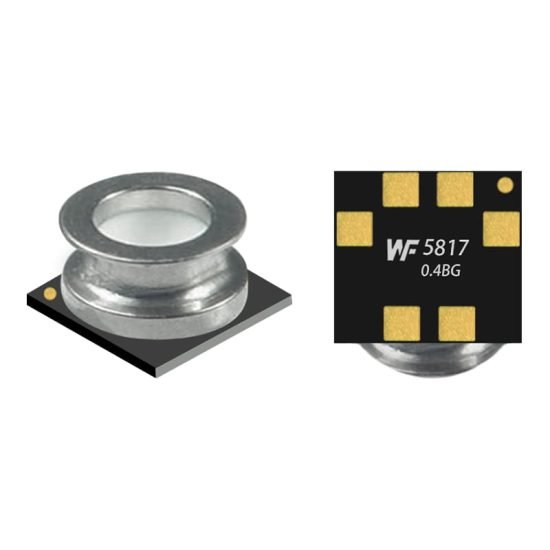
When we are engineering medical devices, measuring within the low-pressure range (typically 0-10 kPa or lower) is a notoriously difficult challenge. The electrical signals generated by such minute pressure changes are incredibly faint and are all too easily drowned out by environmental noise. The WF5817 digital sensor you see, with its metal lid packaging and waterproof adhesive, is essentially designed to construct a Faraday cage effect whilst providing robust mechanical protection. This is all about minimising external electromagnetic interference and physical stress on the MEMS chip.
For us engineers, when selecting a healthcare sensor, the parameter that keeps us up at night often isn’t full-scale accuracy, but rather zero drift and long-term stability. In these low-pressure applications, the gel-filling technology is the unsung hero. The structure of the sensor suggests it likely employs a specific silicone gel protection. This design effectively walls off moisture and corrosive gases, whilst massively reducing the transfer of packaging stress onto the sensitive diaphragm. When the sensor is working away over the long haul, this stress isolation mechanism ensures the linearity of the output signal, avoiding those frustrating reading deviations caused by mismatched thermal expansion coefficients. This is how we guarantee the heart of data sampling: “consistency”.
2. The Feedback Loop: Precise Airflow Control in Ventilators and Anaesthesia Systems
Critical care equipment—think ICU ventilators, transport fans, and anaesthesia machines—relies entirely on a control logic built upon high-speed, high-precision pressure feedback loops. Here, the true value of a medical pressure sensor application is found in its ability to capture instantaneous airway pressure. When the device delivers gas to a patient, the sensor must detect pressure fluctuations within the tubing in a matter of milliseconds, feeding that data back to the microprocessor to tweak turbine speed or valve openings immediately.
If a sensor has too much hysteresis or is sluggish in its response, the ventilator’s output falls out of sync with the patient’s actual need for air, leading to what we call ‘patient-ventilator dyssynchrony’—essentially, a fight between man and machine. High-performance low-pressure sensors can distinguish tiny pressure steps, ensuring that Positive End-Expiratory Pressure (PEEP) stays exactly where it’s set. This level of control is non-negotiable in emergency scenarios; any data deviation could lead to barotrauma or hypoventilation. By integrating rigorously calibrated sensors, manufacturers can ensure their equipment maintains a precise grip on gas volume and pressure, even after weeks or months of continuous running, genuinely safeguarding patient safety.
3. Teasing Out Weak Signals: Linearity Calibration in Oscillometric Measurement
Non-Invasive Blood Pressure (NIBP) monitoring is another area where medical pressure sensors show their technical mettle. Unlike a ventilator that measures fluid pressure directly, an electronic sphygmomanometer uses the pulsation of vessel walls during cuff inflation to work backwards to a blood pressure value. This demands a sensor with incredible dynamic range and resolution—it has to withstand the brute force of 300mmHg cuff pressure whilst simultaneously resolving the pulse wave oscillations superimposed on that static high pressure, which might only be a few mmHg in amplitude.
In this application, the sensor’s linearity is the deciding factor in whether the algorithm can accurately identify “Mean Arterial Pressure” and calculate Systolic and Diastolic values. Inferior sensors often suffer from zero drift after being hit with high pressure, leading to distorted readings. However, sensors built with advanced MEMS processes use an internal ASIC (Application-Specific Integrated Circuit) to perform linearisation compensation across the full temperature range, reducing errors caused by physical deformation to an absolute minimum. This capability for high-precision signal collection doesn’t just improve patient comfort (by reducing the need for those annoying re-inflations); it ensures that early screening data for conditions like hypertension actually holds clinical value.
4. Matching Algorithms with Dynamic Response Time in CPAP Therapy
Continuous Positive Airway Pressure (CPAP) machines are the frontline defence against sleep apnoea. Modern high-end CPAP machines are no longer simple “blowers”; they are intelligent respiratory assistance robots. They need to monitor the patient’s breathing rate, inspiratory flow, and airway collapse in real-time. The low pressure sensor acts as the system’s “sensory organ” here, gathering the foundational data needed for continuous therapy management.
To achieve advanced features like “Exhalation Relief,” the sensor must possess lightning-fast response speeds. As soon as the patient starts to breathe out, the sensor detects the pressure rise, and the system drops the motor speed to lower resistance, making the breath feel far more natural. Compact sensors like the WF5817, with their minimal dead volume, can react to airflow changes instantly. This agility ensures that the machine’s auto-titration algorithms can adjust for the optimal pressure setting based on respiratory events throughout the night. It boosts therapy compliance and builds up a coherent, trustworthy bank of long-term health data.
5. Precision Analysis: Differential Pressure in Pulmonary Function Testing
In Pulmonary Function Testing (PFT) equipment, the demand for accuracy from a digital sensor reaches its peak. Assessing lung capacity, flow rates, and gas exchange efficiency usually relies on measuring the tiny differential pressure across a laminar flow element or orifice plate to calculate flow. This differential pressure is often incredibly faint, requiring the sensor to maintain extreme sensitivity at the very bottom of its range.
In these scenarios, the sensor must shrug off common-mode pressure and react only to the differential signal. MEMS sensors, utilising a precise Wheatstone bridge structure, can capture the most subtle airflow changes, allowing for the plotting of accurate Flow-Volume loops. This is vital for diagnosing respiratory conditions like COPD or asthma. Doctors base their judgements on the extent and nature of lung damage from these figures; any noise or non-linear error introduced by the sensor can directly mislead the diagnosis. Therefore, choosing a sensor with an ultra-low noise floor is the prerequisite for ensuring PFT data carries medical-grade authority.
Konklusjon
Looking back at the entire medical electronic signal chain, the low pressure sensor is the physical foundation that ensures data sampling accuracy and consistency. Whether it is in a ventilator sustaining life, or in a BP monitor and CPAP machine managing chronic conditions, the performance of the sensor directly defines the ceiling of the device’s capability. MEMS devices like the WF5817, employing advanced packaging and calibration technologies, solve the core pain points engineers face when designing precision medical instruments by delivering high Signal-to-Noise Ratio (SNR), low drift, and rapid pressure readings. For technical decision-makers, choosing a proven, high-quality sensor isn’t just a component choice; it is the most solid insurance policy you can buy for the quality of your final clinical data.
Introduksjonen ovenfor skraper bare overflaten av applikasjonene til trykksensorteknologi. Vi vil fortsette å utforske de ulike typene sensorelementer som brukes i ulike produkter, hvordan de fungerer, og deres fordeler og ulemper. Hvis du vil ha mer detaljer om hva som er diskutert her, kan du sjekke det relaterte innholdet senere i denne veiledningen. Hvis du er presset på tid, kan du også klikke her for å laste ned detaljene i denne veiledningen Lufttrykkssensorprodukt PDF -data.
For mer informasjon om andre sensorteknologier, vennligst Besøk Sensors -siden vår.