
목록
Semiconductor pressure sensors represent breakthrough in modern sensing technology, providing ideal pressure detection solutions for compact devices through silicon semiconductor properties and MEMS microfabrication technology.
1. Core Advantages of Semiconductor Pressure Sensors
1.1 Miniaturization Design Implementation
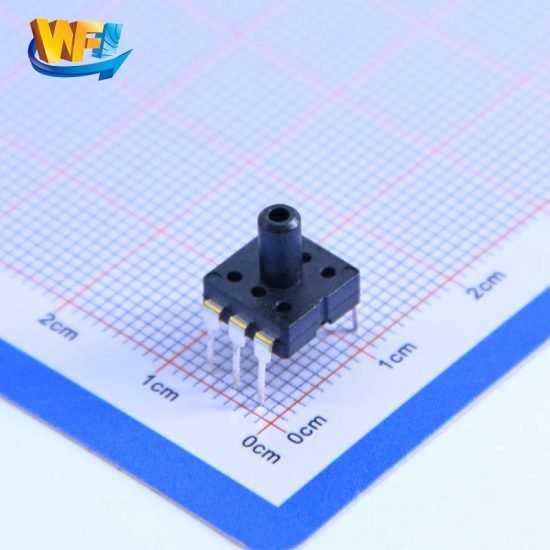
Semiconductor pressure sensors achieve miniaturization levels unattainable by traditional mechanical sensors through MEMS technology manufacturing pressure-sensitive elements on single-crystal silicon wafers. Standard DIP packaging design enables direct PCB soldering, occupying only one-tenth the space of traditional pressure sensors.
1.2 Precision Measurement Performance
Semiconductor strain gauge technology ensures precise measurement capabilities with linearity achieving ±0.5% full-scale accuracy. Sensors utilize constant current drive mode with rated driving current of 1.5mA, output span voltage of 100±40mV, and offset voltage controlled within ±20mV.
1.3 Diverse Pressure Range Coverage
The sensor product line covers 10 different specifications from micro-pressure 4.9kPa to high-pressure 980.7kPa, meeting various application requirements. Each specification undergoes precise calibration ensuring optimal measurement accuracy and stability within respective pressure ranges.
2. Key Technical Features and Performance Parameters
2.1 Semiconductor Material Advantages
Single-crystal silicon material provides excellent mechanical and electrical properties with stable elastic modulus and small temperature coefficient, offering ideal foundation material for pressure sensors. Silicon’s high piezoresistive effect linearity enables precise pressure-to-electrical signal conversion.
2.2 Bridge Design and Circuit Matching
Standard 5kΩ bridge resistance design perfectly matches modern electronic systems, while providing 3.3kΩ low-resistance version specifically adapted for 5V drive circuits. This flexible resistance configuration enables sensors to adapt to different power supply voltage and signal conditioning circuit requirements.
2.3 Temperature Compensation Technology
Sensors integrate advanced temperature compensation circuits maintaining offset voltage temperature characteristics within ±5.0% full-scale and sensitivity temperature characteristics within ±2.5% full-scale across 0°C to 50°C operating temperature range.
3. Manufacturing Process and Quality Control
3.1 MEMS Microfabrication Technology
Semiconductor pressure sensors employ standard MEMS microfabrication processes including photolithography, etching, and diffusion. Silicon wafer surfaces form pressure-sensitive diaphragms and strain gauges through precise microfabrication with diaphragm thickness controlled at micrometer level.
3.2 Packaging Technology and Reliability
Sensors employ hermetic packaging technology effectively preventing external environment effects on internal sensitive components. Standard DIP packaging provides excellent mechanical protection and electrical connection while maintaining miniaturization advantages.
3.3 Quality Testing and Calibration
Each sensor undergoes rigorous quality testing before shipment including pressure hysteresis testing, linearity testing, and temperature characteristic testing. Multi-point calibration technology ensures accuracy consistency across entire pressure range.

4. Application Fields and Practical Cases
4.1 Industrial Automation Applications
In industrial automation, semiconductor pressure sensors find widespread application in pneumatic systems, hydraulic systems, and process control. Their miniaturized design enables installation within space-constrained equipment for real-time pressure monitoring.
4.2 Medical Device Integration
Medical devices demand extremely high precision, stability, and miniaturization from sensors. Semiconductor pressure sensors play crucial roles in blood pressure monitors, ventilators, and oxygen generators, providing reliable technical support for medical diagnosis.
4.3 Consumer Electronics Products
With IoT and wearable device proliferation, consumer electronics increasingly demand miniaturized pressure sensors. Semiconductor pressure sensors provide precise pressure detection functionality for smartwatches, fitness trackers, and smart home devices.
5. Technology Development Trends and Prospects
5.1 Integration Level Enhancement
Future semiconductor pressure sensors will develop toward higher integration levels with signal conditioning circuits and digital processing units integrated onto single chips, further reducing system size.
5.2 Smart Function Enhancement
Next-generation pressure sensors will integrate more intelligent functions including self-diagnosis, self-calibration, and data fusion capabilities. Machine learning algorithm introduction will enable predictive maintenance capabilities.
5.3 New Material Application Expansion
Beyond traditional silicon materials, new semiconductor materials like silicon carbide and gallium nitride will further enhance sensor performance boundaries with better high-temperature characteristics and chemical stability.
결론
Precision semiconductor pressure sensors successfully achieve perfect combination of miniaturization and high precision through advanced MEMS technology and silicon semiconductor manufacturing processes. Their wide pressure range coverage, excellent linear characteristics, stable temperature characteristics, and compact packaging design provide strong technical support for modern electronic device miniaturization development.
위의 소개는 압력 센서 기술 적용의 표면적인 부분에 불과합니다. 우리는 다양한 제품에 사용되는 다양한 유형의 센서 요소, 작동 방식, 장점과 단점을 계속해서 탐구할 것입니다. 여기에서 논의된 내용에 대해 더 자세히 알아보려면 이 가이드 뒷부분의 관련 콘텐츠를 확인하세요. 시간이 촉박한 경우 여기를 클릭하여 이 가이드의 세부정보를 다운로드할 수도 있습니다. 공기 압력 센서 제품 PDF 데이터.
다른 센서 기술에 대한 자세한 내용은 다음을 참조하십시오. 센서 페이지를 방문하십시오.