
목록
1. Measurement Principles of the Chip in Pneumatic Presses
1.1 Chip Package Overview
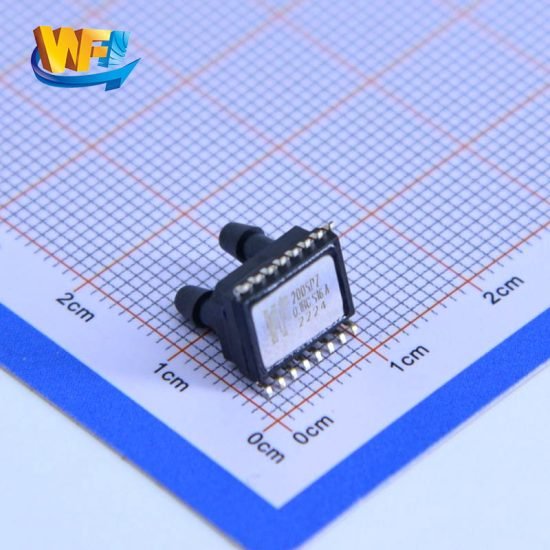
The MEMS differential pressure sensor chip in comes in an SOP16 or DFN package with dual micro-port barbs for pressure lines, directly SMD-mounted on PCBs. Pads on the chip bottom provide power, signal, and ground connections.
1.2 Microstructure and Strain Detection
A thin silicon diaphragm sits between two micro-cavities. Differential pressure causes micron-scale deflection, sensed by an integrated resistive bridge or capacitive element and converted into an electrical signal.
1.3 Signal Conditioning and Output
Built-in low-noise amplifiers and temperature compensation circuits output a standard 0.5–4.5 V analog signal or optional I²C/SPI digital interface, ready for PLC or embedded MCU integration.
1.4 Temperature Drift and Linearization
Calibration data stored in on-chip EEPROM compensates for temperature drift and zero offset, ensuring accuracy better than 0.2% FS from -40 °C to +125 °C.
2. Performance Advantages and Requirements
2.1 High Integration and Lightweight
The chip’s compact package and micro-barb ports reduce volume and weight, ideal for miniaturized pneumatic modules.
2.3 Vibration and Shock Resistance
The silicon MEMS structure resists up to 20 g shock and 10 g vibration, adapting to the dynamic switching of pneumatic presses.
2.4 Cost-effectiveness and Mass Production
Standard semiconductor fabrication and SMD assembly drive down per-unit costs, enabling scalable deployments.

3. Mounting and Reflow Soldering Considerations
3.1 PCB Design and Layout
Allocate clearance around the chip for unobstructed port access.
Design pads per manufacturer recommendations and compatible with no-clean, lead-free reflow paste stencils.
3.2 Reflow Profile Control
Peak temperature below 260 °C, with a total reflow time under 60 s.
Solder the electrical pads first, then secure the port interfaces with low-temperature adhesive or localized soldering.
3.3 Tubing Connection and Sealing
Use soft silicone tubing sized to fit micro-barbs with at least 3 mm insertion depth.
Reinforce connections with miniature clamps or heat-shrink tubing to prevent vibration-related loosening.
3.4 ESD and Cleaning
Follow strict ESD protocols before and after placement, and remove flux residue with ionized air or IPA.
Avoid chlorine-based cleaners to protect MEMS structures.
4. Case Studies and Performance Validation
4.1 Small-scale Pneumatic Assembly Monitoring
On a smart device housing line, the sensor chip tracked cylinder force to ensure proper insertion, boosting yield by 5%.
4.2 Online Diagnosis and Alerts
Deviation of 10% from nominal differential pressure triggers system alerts for potential line blockages or leaks, enabling fast maintenance.
4.3 Data Integration and Cloud Platform
I²C data is converted by an MCU and sent via MQTT to the cloud, where analytics predict equipment health.
4.4 Long-term Stability Testing
After 3000 hours of operation, drift remained under 0.5% FS, confirming suitability for high-cycle applications.
결론
The MEMS differential pressure sensor chip in offers compact integration, rapid response, robust interference immunity, and cost-effective mass production for pneumatic press applications. Proper PCB layout, controlled reflow soldering, secure tubing, and ESD practices are essential to ensure reliable performance. This solution provides precise, lightweight, and efficient monitoring support for automated assembly processes.
위의 소개는 압력 센서 기술 적용의 표면적인 부분에 불과합니다. 우리는 다양한 제품에 사용되는 다양한 유형의 센서 요소, 작동 방식, 장점과 단점을 계속해서 탐구할 것입니다. 여기에서 논의된 내용에 대해 더 자세히 알아보려면 이 가이드 뒷부분의 관련 콘텐츠를 확인하세요. 시간이 촉박한 경우 여기를 클릭하여 이 가이드의 세부정보를 다운로드할 수도 있습니다. 공기 압력 센서 제품 PDF 데이터.
다른 센서 기술에 대한 자세한 내용은 다음을 참조하십시오. 센서 페이지를 방문하십시오.


