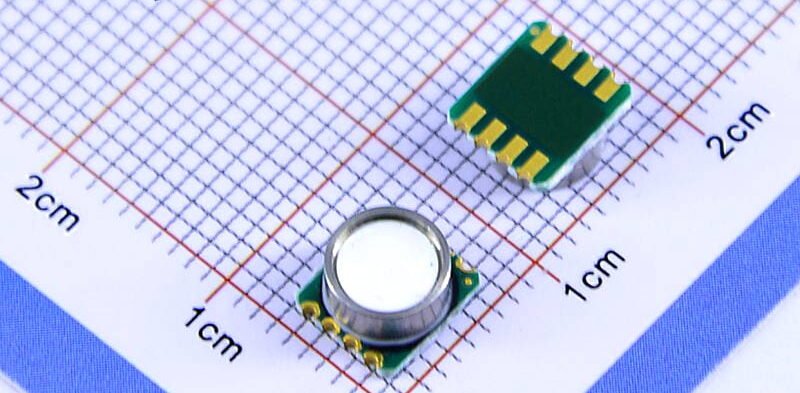
Temperature Compensation and Calibration Advantages
Compensation Structure Explanation
The die integrates a thick-film resistor network on a ceramic substrate to complete factory zero calibration and wide-range temperature compensation. This approach significantly reduces temperature-induced drift across -40°C to +125°C, lowering field recalibration frequency and improving long-term stability of transmitters in industrial environments.
Impact on Manufacturing and Maintenance
Factory calibration reduces post-production trimming and test workloads for manufacturers, while end users benefit from longer calibration intervals and lower maintenance costs. These gains translate into clear economic and operational advantages for high-volume and high-reliability deployments.
Robust Mechanical Design and Easy Integration
Packaging and Mechanical Strength
The die uses a dual-inline (DIP) package with the sensitive silicon chip mounted on a 1 mm ceramic substrate. This structure offers high overload resistance and effective protection for the silicon element, improving transmitter resistance to shock, vibration and overpressure common in industrial settings.
Assembly and Production Efficiency
The standard DIP form factor allows direct PCB soldering, which simplifies SMT or through-hole assembly steps, shortens production cycles, and reduces labor and rework costs. The compact layout supports modular transmitter designs and cost-controlled mass production.
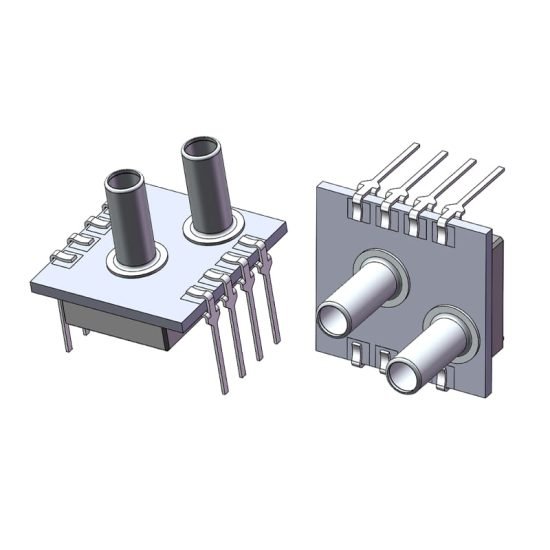
Accurate Gas Measurement and Wide Applicability
Range and Media Matching
The die is optimized for a 10 kPa range and dry, noncorrosive gases (for example, air). That range fits differential measurements on orifices, venturi tubes, and ducts, covering filter monitoring, gas flow measurement, and building HVAC pressure control in industrial and building automation contexts.
Signal Compatibility
Designed for constant-current excitation, the die’s output is compatible with standard amplifier and A/D front ends. This ensures linearity and repeatability, enabling transmitters to maintain consistent calibration processes and stable long-term outputs.
Electrical Matching and Quality Contro
Electrical Design Considerations
To achieve high resolution and low noise, the front end should pair constant-current excitation with low-noise amplification and a high-resolution A/D converter. Proper PCB routing, grounding and filtering maximize die performance and reduce the impact of temperature drift and external interference on readings.
Production Testing and Traceability
Production tests should include zero-drift checks, temperature cycling, long-term aging, and batch traceability records. Integrating these test results into yield analysis helps detect consistency issues early and guides supply-chain and process improvements, ensuring long-term field reliability.
주요 시사점
Differential-pressure die sensors provide a factory-calibrated, temperature-compensated, mechanically robust, and electrically compatible core for differential-pressure transmitters. With proper mechanical and electrical integration and strict production testing, these dies convert component-level advantages into stronger, more reliable end products. Choosing the right die means choosing stability and accuracy, and it equips a measurement system with dependable core capability.
위의 소개는 압력 센서 기술 적용의 표면적인 부분에 불과합니다. 우리는 다양한 제품에 사용되는 다양한 유형의 센서 요소, 작동 방식, 장점과 단점을 계속해서 탐구할 것입니다. 여기에서 논의된 내용에 대해 더 자세히 알아보려면 이 가이드 뒷부분의 관련 콘텐츠를 확인하세요. 시간이 촉박한 경우 여기를 클릭하여 이 가이드의 세부정보를 다운로드할 수도 있습니다. 공기 압력 센서 제품 PDF 데이터.
다른 센서 기술에 대한 자세한 내용은 다음을 참조하십시오. 센서 페이지를 방문하십시오.