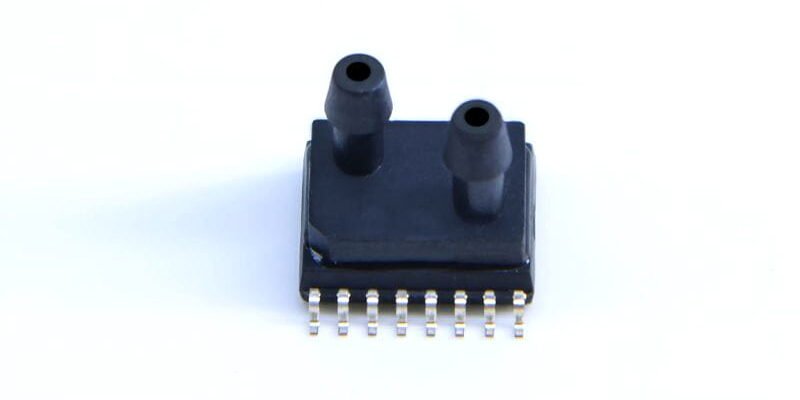
MEMS pressure sensors enable 3D navigation by monitoring atmospheric pressure changes, converting planar GPS guidance into spatial positioning. These sensors measure barometric variations to calculate altitude, filling GPS vertical blind spots in urban canyons and tunnels where satellite signals fail.
सूची
1. Why Automotive Navigation Needs Altitude Sensing
1.1 GPS Vertical Positioning Gaps
GPS achieves 3-5m horizontal accuracy but suffers 10-15m vertical errors due to satellite geometry. In urban environments, multipath interference degrades altitude data completely. Automotive navigation pressure sensors provide independent altitude references by measuring atmospheric pressure.
1.2 Overpass & Tunnel Scenario Demands
Identical GPS coordinates may represent surface roads, elevated decks, or underground passages. Without altitude data, navigation systems cannot determine vehicle levels. Altimeter pressure sensors distinguish ±1m elevation differences, critical for identifying bridge levels and tunnel entries.
1.3 Barometric Measurement Fills Positioning Shortfalls
Pressure drops ~1 hPa per 8.3m elevation gain. High-resolution pressure sensors deduce altitude changes from precise barometric measurements. Kalman fusion with GPS elevation achieves 3-5× better accuracy than single-source data, maintaining continuous vertical sensing even when satellite signals vanish.
2. MEMS Pressure Sensor Core Mechanisms
2.1 Atmospheric Pressure to Altitude Conversion Logic
Sensors employ International Standard Atmosphere models: H = 44330 × [1 – (P/P₀)^0.1903], where P is current pressure and P₀ is sea-level reference (1013.25 hPa at 15°C). Systems adjust P₀ using real-time meteorological data, eliminating weather-induced pressure fluctuations through dynamic calibration.
2.2 Silicon Membrane Deformation & Signal Conversion
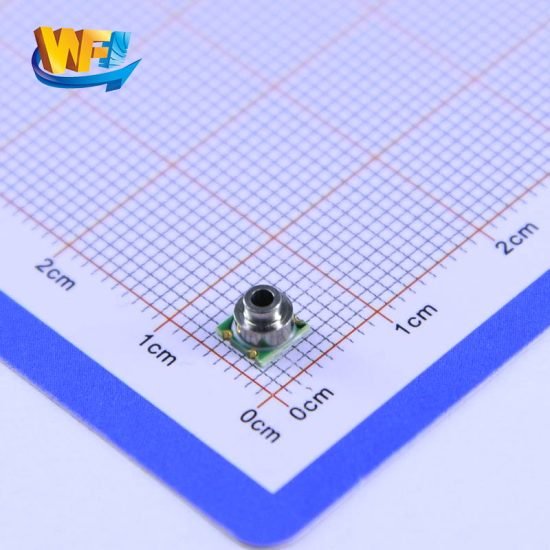
MEMS micromachining fabricates micron-thick pressure-sensitive membranes on silicon wafers. Atmospheric pressure induces elastic deformation, converted to resistance changes by piezoresistive elements, then to voltage via Wheatstone bridges. Fully integrated chips output digitized pressure data directly.
2.3 Temperature Compensation & Digital Calibration
Uncompensated sensors produce hundreds of pascals error across -40°C to +125°C automotive ranges. Digital output sensors integrate temperature monitors, storing factory calibration coefficients in non-volatile memory. Embedded processors apply real-time compensation algorithms, achieving ±0.5 hPa absolute accuracy (±4m altitude equivalent).
3. Digital Interfaces & System Integration
3.1 I²C vs SPI Protocol Selection
Embedded pressure sensors equip I²C (two-wire: SCL, SDA) or SPI (four-wire: SCLK, MOSI, MISO, CS) interfaces. I²C’s 100-400 kHz rates satisfy 1-10 Hz navigation updates with simple wiring. SPI’s tens-of-MHz speeds suit high sampling rate sensors. I²C gains preference for multi-device compatibility and flexible mounting.
3.2 Real-Time Data Processing in Embedded Systems
Microcontrollers configure sensor registers for measurement modes and sampling rates (1-10 Hz typical, up to 1 kHz capable). 24-bit calibrated data outputs in pascals/hectopascals. Hosts time-sync barometric data with GPS/IMU, feeding Kalman filters that assign sensor weights based on signal strength—prioritizing GPS when strong, elevating barometric weight in weak zones.
4. Accuracy & Stability: Key Performance Metrics
4.1 Absolute vs Relative Accuracy Practical Significance
Absolute accuracy (±0.5 hPa typical) determines actual altitude calculation capability. Relative accuracy (±0.1 hPa in premium units) reflects change detection sensitivity—distinguishing ~0.8m elevation differences. Navigation systems prioritize relative accuracy for tracking uphill/downhill driving and tunnel entry, not precise sea-level elevation.
4.2 High Resolution Achieves Meter-Level Measurement
16-bit ADCs spanning 300-1100 hPa represent ~0.012 hPa per count (~0.1m altitude). 24-bit ADCs boost resolution to 0.00005 hPa (centimeter-scale theoretically). Digital filters suppress noise, elevating usable resolution to 0.8-1m—sufficient to differentiate surface roads from elevated bridges and tunnel entries/exits.
4.3 Long-Term Drift & Environmental Adaptability
Quality MEMS sensors specify ±0.5 hPa/year stability (±4m altitude equivalent annually). Gel packaging isolates moisture while preserving pressure paths. -40°C to +125°C operating ranges cover arctic to engine compartment environments. Anti-vibration design prevents false signals during rough-road driving.
5. Real-World Performance
5.1 Multi-Level Road Recognition Capability
In complex urban interchanges, identical GPS coordinates may represent ground, second-tier, or third-tier loop roads. Pressure sensors add physical constraints for level identification—detecting pressure drops during ramp ascents, stabilization upon reaching elevated platforms. Testing shows altitude-integrated navigation achieves 40%+ higher accuracy than pure GPS in overpass scenarios.
5.2 Continuous Tunnel Positioning Assurance
GPS signals vanish in long tunnels while inertial systems diverge from accumulated errors. Altimeter pressure sensors become sole reliable vertical positioning means. Monitoring pressure change rates, systems deduce vehicle travel distance/direction inside tunnels, maintaining <10m relative accuracy until GPS signal recovery enables smooth transitions.
5.3 Energy Optimization & Range Management
Electric vehicle consumption correlates with altitude variations—climbing requires extra energy, descending enables regenerative recovery. Navigation systems integrating altimeter pressure sensors calculate route ascent/descent totals, estimating consumption differences. Altitude-aware planning reduces mountain-driving energy use by 5-12%. Ultra-low power (<3μA standby) negligibly impacts overall vehicle consumption.
निष्कर्ष
From Planar to 3D, Safeguarding Precise Positioning MEMS pressure sensors inject vertical sensing into automotive navigation through precise atmospheric pressure measurement. Silicon micromachining converts subtle pressure changes to accurate digital signals, with temperature compensation ensuring all-condition stability. Meter-level resolution and millisecond response enable real-time tracking of vehicle transitions within 3D road networks.
उपरोक्त परिचय केवल दबाव सेंसर प्रौद्योगिकी के अनुप्रयोगों की सतह को खरोंचता है। हम विभिन्न उत्पादों में उपयोग किए जाने वाले विभिन्न प्रकार के सेंसर तत्वों, वे कैसे काम करते हैं, और उनके फायदे और नुकसान का पता लगाना जारी रखेंगे। यदि आप यहां चर्चा की गई बातों पर अधिक विवरण चाहते हैं, तो आप बाद में इस गाइड में संबंधित सामग्री देख सकते हैं। यदि आप पर समय की कमी है, तो आप इस गाइड का विवरण डाउनलोड करने के लिए यहां क्लिक भी कर सकते हैं वायु दाब सेंसर उत्पाद पीडीएफ डेटा.
कृपया अन्य सेंसर प्रौद्योगिकियों पर अधिक जानकारी के लिए हमारे सेंसर पेज पर जाएँ.