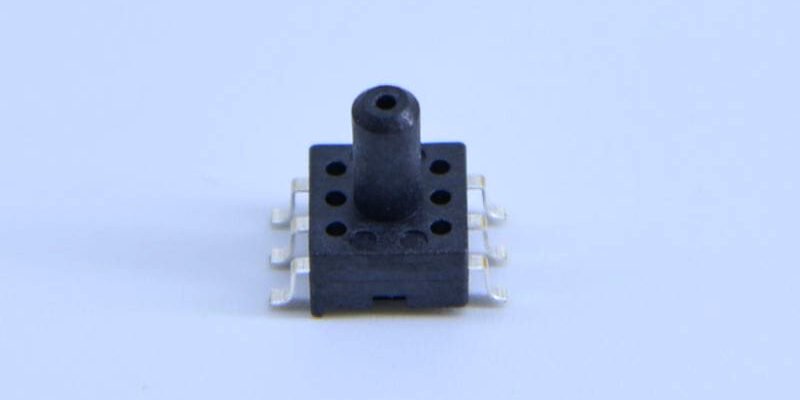
Outdoor devices face complex pressure variations requiring high resolution and stability. Traditional analog sensors struggle with signal interference. Digital pressure sensors like WF5803C-02BA integrate sensing elements, signal conditioning, and ADC in one module, outputting clean digital signals directly to microcontrollers.
Papa lima
1. Core Technical Principles of Digital Pressure Sensors in Outdoor Environments
Digital pressure sensors integrate MEMS piezoresistive elements with on-chip signal processing. When pressure deforms the silicon diaphragm, resistance changes are amplified, temperature-compensated, and digitized internally. This eliminates analog signal noise and simplifies system design significantly.
24-bit ΔΣ ADC Achieves Millimeter-Level Precision
The 24-bit ΔΣ ADC divides the 14-bar range into 16 million levels, achieving 0.08mm resolution per LSB. Oversampling and noise-shaping push quantization noise to high frequencies, delivering exceptional low-frequency precision ideal for slow pressure changes in depth measurement applications.
Gel Protection Layer and Anti-magnetic Stainless Steel Cap Design
316L stainless steel caps shield against magnetic interference and corrosion while providing mechanical strength. Internal gel layers prevent water ingress yet maintain pressure transfer linearity. This dual protection enables 5x overpressure tolerance—70-bar impacts for 14-bar rated sensors.

2. I2C and SPI Communication Protocols in Pressure Measurement
Digital sensors support both I2C (2-wire, multi-device bus) and SPI (high-speed, full-duplex) interfaces. I2C’s simplicity suits distributed systems like weather stations, while SPI serves high-update-rate applications. Both protocols enable direct microcontroller communication without external components.
Simplified Protocol Reduces Integration Complexity
Modern sensors require no register configuration—they auto-initialize with factory-optimized parameters. Users simply send read commands to retrieve pressure and temperature data. Mode switching uses single commands rather than complex register sequences, accelerating development and reducing debugging time.
Low-Power Mode Optimizes Battery Life
Multiple operating modes balance performance and consumption. Continuous mode samples at maximum rate (hundreds of microamps) for real-time control. On-demand mode sleeps at <1µA, waking only for triggered measurements. Dive computers leverage dynamic switching to achieve 100+ hour battery life.
3. Achieving 1cm Water Depth Resolution in Depth Measurement Systems
One centimeter water depth equals 1 millibar pressure change—0.007% of 14-bar range. Achieving this demands 24-bit resolution, ultra-low noise, and <0.02% nonlinearity. Factory calibration across full temperature and pressure ranges ensures consistent accuracy without user intervention.
Factory Calibration Coefficients Ensure Long-term Stability
Multi-point calibration data stored in non-volatile memory compensates for silicon variations, packaging stress, and temperature drift. Typical long-term drift is <0.1% full-scale annually (14 millibar/year for 14-bar sensors). Calibration survives power loss, eliminating field recalibration needs.
Integrated Temperature Sensor Enables Dual Measurement
On-chip 16-bit temperature sensors (0.01°C resolution) enable precise thermal compensation while providing ambient temperature output. This eliminates external temperature sensors in dive computers, simplifying hardware. Temperature monitoring also supports system health diagnostics and anomaly detection.
4. Waterproof Pressure Sensor Reliability in Harsh Environments
IP68-rated sensors withstand 1+ meter submersion for 24+ hours. 316L stainless steel resists seawater corrosion indefinitely. Gel protection prevents ion penetration while maintaining response speed. Laser-welded or precision-sealed interfaces ensure zero leakage under temperature cycling and high-pressure conditions.
Stainless Steel Shell Handles Extreme Pressure Impacts
Five-times overpressure capability protects against accidental depth excursions. When pressure exceeds limits, diaphragms contact internal stops, transferring loads to metal shells rather than fragile silicon. Thousands of overpressure cycles demonstrate no performance degradation or accuracy loss.
Environmental Adaptability in Real Applications
Waterproof pressure sensor application scenarios are extremely extensive. In diving equipment, sensors are integrated into dive computers, underwater cameras, and depth gauges, monitoring dive depth and ascent rate in real-time to prevent decompression sickness risks. In underwater robots and unmanned underwater vehicles, sensors provide precise depth information for attitude control and trajectory planning, cooperating with inertial measurement units IMUs for underwater navigation. In hydrological monitoring, sensors are deployed in rivers, lakes, and groundwater wells, recording water level changes long-term, providing data support for water resource management and flood warning.
The harshness of marine environments places even higher demands on sensors. Seawater salinity, temperature changes, and biofouling all affect sensor performance. High-quality waterproof pressure sensors fully consider these factors in design, with gel protection layers not only waterproof but also possessing certain anti-biofouling capabilities, reducing algae and shellfish growth on sensor surfaces. For applications requiring long-term immersion in seawater, regular cleaning of sensor surfaces is recommended, which doesn’t affect waterproof performance but can maintain rapid response in pressure transfer.
Industrial fluid measurement is another important application direction. In petrochemical, water treatment, and pharmaceutical industries, sensors need to contact various chemical media, from acid-base solutions to organic solvents. The chemical stability of 316L stainless steel enables safe use in most industrial fluids, but for highly corrosive media like concentrated sulfuric acid or hydrofluoric acid, additional protective coatings or higher-grade materials may be required. During selection, the chemical properties of measured media must be clarified to ensure sensor material compatibility.
5. Key Considerations for Selecting High-Resolution Pressure Sensors
Facing the dazzling array of digital pressure sensor products on the market, how to select the most suitable model for one’s application is a problem engineers and technical decision-makers must face. Selection needs to comprehensively consider range matching, accuracy requirements, interface compatibility, power constraints, and environmental conditions across multiple dimensions. Incorrect selection not only wastes costs but may also lead to substandard system performance or even safety hazards.
Range selection is the primary consideration. Sensor measurement accuracy is typically expressed as a percentage of full scale, with excessively large ranges reducing effective accuracy in actual applications. For example, applications measuring 10-meter water depth can achieve higher resolution using 2-bar range sensors than 14-bar range sensors. But ranges shouldn’t be selected too small either, requiring sufficient overpressure margin to handle unexpected situations. General experience is selecting sensors with ranges 1.5 to 2 times the maximum working pressure, ensuring both accuracy and safety.
Matching Strategy Between Technical Specifications and Actual Needs
Accuracy indicators require careful interpretation. Datasheets typically provide multiple accuracy parameters, including nonlinearity error, hysteresis, repeatability, and total error band TEB. For outdoor equipment, the most critical is total error, comprehensively considering all error sources’ performance within the specified temperature range. High-quality digital pressure sensors can control total error within 0.1% of full scale, meaning approximately 14 millibars or 14cm water depth error for 14-bar sensors, meeting most application needs. If applications have higher accuracy requirements, 0.05% accuracy grade models can be selected, though costs increase accordingly.
Response time is an important parameter in dynamic measurements. Different applications have vastly different response time requirements. Water level monitoring stations updating data once per minute have no strict response time requirements. But underwater robot attitude control requires dozens of data updates per second, demanding fast sensor response capability. Digital pressure sensor response time depends on ADC sampling rate and digital filter settings, allowing tradeoffs between response speed and noise suppression by adjusting operating modes. In high-speed mode, response time can be shortened to several milliseconds, though power consumption increases and noise correspondingly rises.
Regarding interface compatibility, confirmation of communication protocols supported by the master microcontroller is needed. Most modern MCUs integrate I2C and SPI hardware peripherals, but voltage level compatibility still requires attention. Sensors typically operate in the 1.8V to 3.6V voltage range, requiring level conversion circuits if the master uses 5V logic levels. Bus rate matching also needs consideration, with standard I2C typically running at 100kHz, fast mode reaching 400kHz, while SPI can support several MHz or even higher frequencies, requiring balance between data update needs and system design complexity during selection.
Power constraints are crucial in battery-powered devices. Sensor quiescent current, operating current, and power consumption characteristics in different operating modes need to match the system’s overall power budget. For long-term deployed monitoring equipment, selecting sensors supporting ultra-low-power sleep modes can significantly extend battery life. Simultaneously consider the time and energy overhead for the master to wake the sensor, as frequent sleep-wake cycles may instead increase overall power consumption, requiring finding the optimal operating mode switching strategy through actual testing.
Environmental conditions include operating temperature range, humidity, and chemical media compatibility. Most digital pressure sensors have operating temperature ranges of -40 to +85°C, covering the vast majority of outdoor environments. But if application scenarios involve polar or desert extreme temperature conditions, extended temperature range models need selection. Humidity’s impact on electronic devices mainly manifests in condensation and corrosion, with waterproof-packaged sensors unaffected by humidity themselves, but attention needed for pin and connector protection. Chemical media compatibility was mentioned earlier, requiring confirmation that sensor shell materials and sealing materials can contact measured fluids long-term without degradation.
Hopena
Digital pressure sensors combine MEMS miniaturization, 24-bit precision, and robust waterproofing into complete measurement solutions. Factory calibration, integrated temperature sensing, and simplified interfaces reduce development burdens. From 1cm depth resolution to 5x overpressure tolerance, these sensors prove indispensable for outdoor equipment reliability and performance.
ʻO ka mea i hōʻikeʻia ma luna nei e hōʻike wale ana i kaʻili o nā noi o kaʻenehanaʻo Sensor Sensor. E hoʻomau mau mākou i nāʻano likeʻole o nāʻano sensor i hoʻohanaʻia ma nā huahana likeʻole, pehea lākou e hana ai, a me kā lākou hanaʻana. Inā makemakeʻoe eʻoi aku ka nui o nā kiko'ī ma ka mea i kamaʻilioʻia ma aneʻi, hiki iāʻoe ke nānā i nāʻike pili ma hope o kēia alakaʻi. Ināʻoe e kaomi no ka manawa, hiki iāʻoe ke kaomi ma aneʻi e hoʻoiho i nā kiko'ī o kēia mau alakaʻi ʻO kaʻikepili o ka ea eʻike ai i kaʻikepili PDF. ^.
No nāʻike hou aku ma nāʻenehana loea'ē aʻe, eʻoluʻolu E kipa i kā mākouʻaoʻaoʻike. ^.