- Le hais Braiteoirí WF
Sleep apnoea machines rely on several sensing elements to work well — pressure sensors, airflow sensors and so on. A digital air pressure sensor is central to picking up breathing signals, controlling pressure and closing the control loop. This piece looks at the requirements from accuracy, resolution, dynamic response, environmental robustness and system integration angles, giving practical engineering recommendations to help with component selection and design.
Catalóg
1. the core role of digital air pressure sensors in sleep apnoea
The job of a sleep apnoea machine is to stabilise and assist breathing. That depends on reliably detecting inhale/exhale timing, peak pressures and phase changes. A digital air pressure sensor must give stable, repeatable readings in the low-pressure range so the control algorithm can react on every breath. For home use, the sensor also needs to run reliably in high-humidity environments (often alongside humidifiers). Design factors such as size, connectivity and pressure drop (in cooperation with airflow sensors) affect patient comfort and device noise. In practice, an enhanced digital pressure sensor often hits the sweet spot between cost and integration: digital output shortens integration time, reduces the need for external amplifiers or filters, and speeds up validation and production.
system-level advantages of digital output
Digital interfaces (I²C / SPI etc.) make it easier for the controller to read and calibrate data, and reduce noise and drift introduced by analogue signal chains. For products with tight time-to-market demands, an enhanced digital sensor cuts hardware and debug time and gives traceable compensation data.

2. Accuracy and resolution
When you’re tracking breathing waveforms, resolution and total error band are top concerns. A high-resolution pressure sensor can resolve small pressure changes, which is crucial for detecting inhale/exhale transitions and triggering pressure adjustments. In practice, the sensor’s effective resolution should match the system’s smallest detectable pressure step (for instance, about 0.01–0.05 cmH₂O depending on how the control is tuned). Total error band — including linearity, temperature drift and long-term drift — must be kept within acceptable margins to avoid cumulative offset in the control loop. Digital sensors with internal calibration and compensation cut down external calibration needs and support long-term usability.
quantifying “high resolution” and “high sensitivity”
In engineering terms, resolution is tied to ADC-equivalent bits versus sensor noise floor; sensitivity is the change in output per unit pressure. Both together determine whether you can capture tiny breathing motions. When choosing a sensor, look at noise-equivalent pressure (NEP) and effective resolution, not just raw bit depth.
3. Dynamic response and sampling
Breathing signals sit mostly at very low frequencies (typical breathing 0.2–0.5 Hz; fast breathing can reach a few Hz). Your sensor and sampling plan must capture low-frequency waveforms accurately while still responding to short-term events (snoring spikes, sudden peaks). You don’t need extremely high sampling rates, but you should sample well above Nyquist to keep waveform fidelity and avoid phase lag. In practice, a 10–200 Hz sampling window is common: basic home units often use 50–100 Hz; devices needing more diagnostic detail may go higher. Bandwidth selection must go hand-in-hand with filtering strategy to keep high-frequency noise out of the measurement channel.
balancing sample rate and filters
Too low a sample rate loses phase info; too high means more data and power use. A practical approach is to set the sample rate from the control algorithm’s allowable latency, then select digital filter order to balance response time, data volume and noise suppression.
4. Environmental robustness
Home sleep machines often run with humidifiers, so sensors must tolerate high relative humidity and resist condensation that can distort readings. Good mechanical packaging and airflow routing, plus moisture-control measures (hydrophobic coatings, micro-porous waterproof membranes), are necessary. Digital air pressure sensors typically include temperature compensation and linearisation to reduce temperature-caused errors. Long-term stability (drift) must be demonstrated with accelerated ageing and environmental cycling tests; home devices should keep errors within acceptable limits for years. Factory calibration, built-in compensation parameters and easy system-level calibration (for example, field re-zeroing) all reduce maintenance cost and improve user experience.
practical humidity and condensation control
Avoid routing the sensor directly into the humidifier outlet; add a small chamber or filter so humid air doesn’t directly hit the sensing diaphragm. Using moisture-resistant packaging and tiny membrane filters at the port greatly improves stability in humid conditions.
5. Integration, mechanical & electrical interfaces
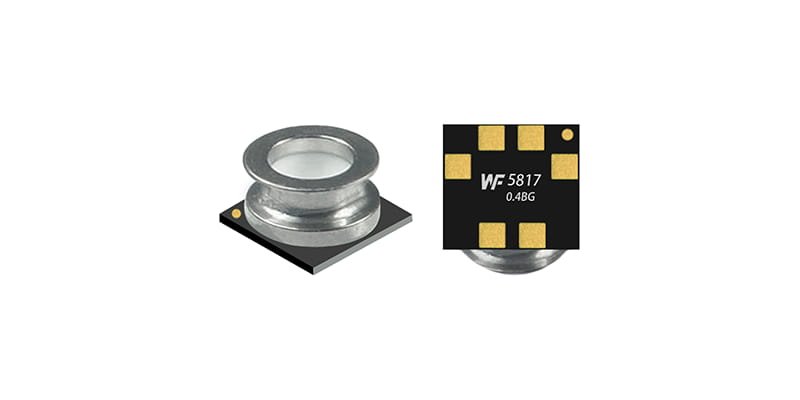
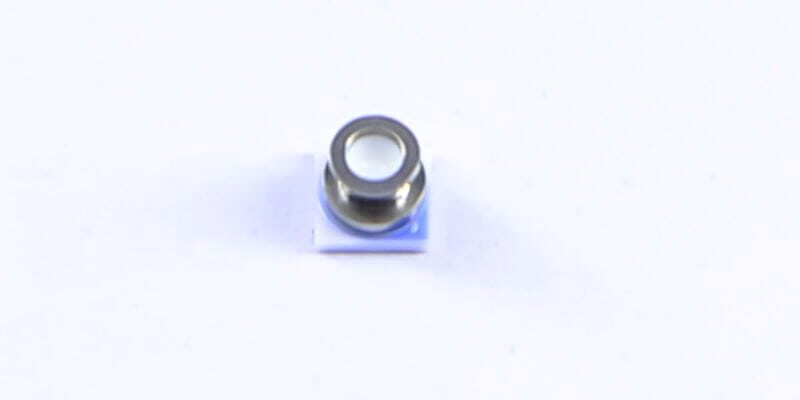
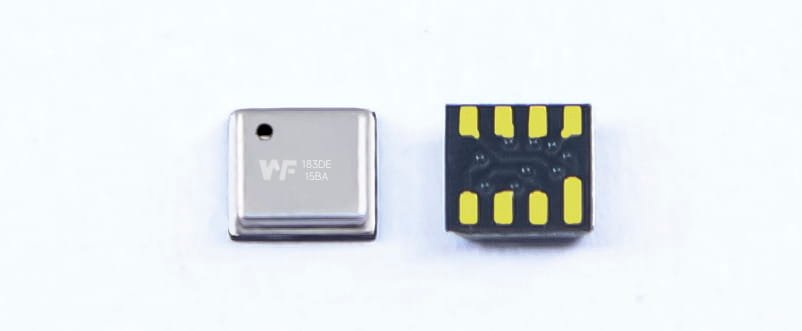
CPAP designers care about volume and weight, so sensor packaging must balance low profile with a reliable gas path. The two packages in the photo — a vented metal can and an SMD with a central port — suit different needs: rugged modules vs low-profile PCB-mounted parts. Electrically, digital outputs reduce analogue chain noise; if analogue outputs are used, the front-end amplifier and ADC matching and shielding matter. Noise control also means isolating mechanical vibration, pump/fan-transmitted noise, and careful PCB layout (analogue/digital grounds, power decoupling).
how package choice affects product design
Smaller packages help miniaturise devices but can increase airflow resistance or complicate moisture protection. Engineers should weigh shape, aerodynamic impedance and anti-moisture performance to pick the best compromise.
6. System-level considerations & test validation
Sensor choice can’t be done in isolation — validate it together with airflow sensors, control software and the mechanical design. Key tests include static accuracy, dynamic response, temperature-humidity cycling, long-term drift and contamination resistance. Manufacturing needs incoming inspection, factory calibration and batch-to-batch parameter checks. Enhanced digital sensors simplify integration but require a reliable supply chain and consistent calibration to avoid extra tuning later. Before launch, run whole-system tests in representative environments (high humidity, low temp, daily vibrations) to ensure long-term reliability.
Conclúid
For sleep apnoea machines, prefer enhanced digital air pressure sensors: they give stable digital outputs, built-in temperature compensation and shorter integration time. When picking a part, watch for effective resolution and noise-equivalent pressure, total error band and temperature drift, sampling/ bandwidth match, moisture resistance of the package, and digital interface compatibility. For higher sensitivity needs, combine a low-pressure-drop airflow sensor in the gas path to reduce motor workload and noise. Combine these choices with a solid validation plan to keep patient comfort while delivering reliable measurements and a competitive product.
Ní dhéanann an réamhrá thuas ach scratches ar dhromchla iarratais na teicneolaíochta braite brú. Leanfaimid orainn ag iniúchadh na gcineálacha éagsúla eilimintí braite a úsáidtear i dtáirgí éagsúla, conas a oibríonn siad, agus a gcuid buntáistí agus míbhuntáistí. Más mian leat tuilleadh sonraí a fháil ar a bhfuil pléite anseo, is féidir leat an t-ábhar gaolmhar a sheiceáil níos déanaí sa treoir seo. Má tá brú ama ort, is féidir leat cliceáil anseo freisin chun sonraí na dtreoracha seo a íoslódáil Sonraí PDF Táirge Braiteora Aeir Brú Aeir.
Le haghaidh tuilleadh eolais ar theicneolaíochtaí braiteora eile, le do thoil Tabhair cuairt ar ár leathanach braiteoirí.