
Catalogue
Sensor technology in modern electric pressure cookers has become the core component for achieving precise pressure control. This article analyzes the application of WF 282A MEMS pressure sensor in electric pressure cookers, focusing on its working principles and technical characteristics in gas pressure sensitive force control. Through in-depth analysis of key technologies such as displacement detection, temperature compensation, and safety control, it demonstrates how modern sensor technology enhances the safety and cooking efficiency of electric pressure cookers.
1. Basic Working Principles of Sensors
Détection de déplacement pour la surveillance de la pression
WF 282A MEMS pressure sensor uses silicon piezoresistive technology to achieve accurate measurement of pressure inside the pot by detecting minute displacement changes of the inner pot. When steam pressure is generated inside the electric pressure cooker, the inner pot undergoes corresponding displacement, and the sensor’s sampling section can sense this displacement change and convert it into electrical signals. The advantage of this displacement detection method lies in its stable and reliable physical quantity conversion, with minimal influence from environmental temperature and humidity, maintaining good measurement accuracy in the high-temperature, high-humidity environment of electric pressure cookers. The sensor’s built-in precision adjustment conversion amplifier circuit ensures signal linearity, enabling accurate capture and processing of every 1KPa pressure change.
Technologie de compensation de température
The collaborative work of temperature sensors and pressure sensors is key to achieving precise control. Since the internal temperature of electric pressure cookers can reach above 120°C, sensors must possess excellent high-temperature resistance. WF 282A sensor adopts temperature compensation design, maintaining stable performance within the temperature range of -40°C to 125°C. Temperature compensation circuits monitor environmental temperature changes in real-time and correct pressure measurement results, ensuring accurate pressure readings under different temperature conditions. This temperature compensation technology significantly improves sensor measurement reliability in high-temperature environments.
2. Safety Control System Design
Mécanismes de protection de la sécurité multiples
The safety control system of electric pressure cookers adopts multiple protection design, with pressure sensors serving as the first line of defense, capable of real-time monitoring of pressure changes inside the pot. When pressure exceeds set thresholds, sensors immediately send signals to the control system, triggering automatic pressure reduction programs. The system also includes temperature sensors as a second layer of protection, judging pressure status by monitoring internal temperature. This dual-sensor design ensures safe operation even if a single sensor fails. The rapid response characteristics of sensors enable the entire safety control system to react quickly to pressure anomalies, effectively preventing safety accidents.
Surveillance de la pression en temps réel
Sensor systems can achieve continuous monitoring of pressure inside the pot, with pressure detection accuracy reaching 1KPa level. Through analog-to-digital converters that transform analog signals into digital signals, microprocessors can analyze pressure data in real-time and make corresponding control decisions. This real-time monitoring mechanism not only improves cooking process safety but also adjusts pressure parameters according to different food requirements, achieving personalized cooking control. The high-precision measurement capability of sensors ensures pressure control accuracy, enabling electric pressure cookers to work under optimal pressure conditions.
3. Anti-interference and Cleaning Design
Optimisation de la structure anti-bloquant
WF 282A sensor adopts specialized anti-blocking design, with its sampling section specially treated to effectively prevent food residue and oil from affecting the sensor. The sensor housing uses stainless steel materials with good corrosion resistance, capable of withstanding the high-temperature, high-pressure environment inside electric pressure cookers. The sensor’s interface design considers easy cleaning requirements, with smooth surface treatment reducing dirt adhesion, allowing maintenance personnel to conveniently perform cleaning and maintenance operations. This anti-blocking design ensures long-term stable sensor operation, reducing measurement errors caused by contamination.
Traitement et amplification du signal
Le capteur’s built-in signal processing circuit uses advanced amplification technology, converting weak physical signals into easily processed electrical signals. Circuit design fully considers electromagnetic interference effects, adopting shielding and filtering techniques to improve signal quality. The linearity design of signal amplification circuits ensures precise correspondence between output signals and input pressure, which is crucial for achieving accurate pressure control. The circuit’s low temperature drift characteristics allow sensors to maintain stable performance during temperature changes, improving overall system reliability.
4. Steam Pressure Detection Mechanism
Adaptabilité de l'environnement de vapeur à haute température
Electric pressure cookers generate high-temperature, high-pressure steam during operation, requiring sensors to maintain stable operation in such harsh environments. WF 282A sensor’s high-temperature resistance design enables normal operation in temperatures above 120°C, with sensor materials selected for excellent thermal stability including silicon materials and metal packaging. High humidity in steam environments challenges sensor electrical performance, with sensors adopting sealed design and moisture-resistant coatings to ensure circuit reliability. This high-temperature steam environment adaptability enables sensors to provide accurate pressure measurement under actual electric pressure cooker working conditions.
Réponse de pression dynamique
The dynamic response characteristics of sensors are crucial for electric pressure cooker control performance. When pressure inside the pot changes, sensors can respond quickly and output corresponding signals. The sensor’s frequency response characteristics are optimized to accurately capture subtle differences in pressure changes. This rapid response capability enables control systems to adjust heating power timely, achieving precise pressure control. The sensor’s dynamic performance is also reflected in its sensitivity to pressure fluctuations, with even minute pressure changes being accurately detected, providing a foundation for precision control.
5. Integrated Control System
Gestion de la pression intelligente
Sensor systems in modern electric pressure cookers are closely integrated with microprocessors, forming intelligent pressure management systems. Real-time pressure data provided by sensors is analyzed by microprocessors, enabling systems to automatically adjust pressure parameters according to preset cooking programs. This intelligent management not only improves cooking efficiency but also optimizes cooking conditions based on different food characteristics. The sensor’s digital output makes system integration more convenient, reducing interference issues in analog signal transmission. Integrated design also improves system reliability and maintainability, providing users with better experience.
Structure compacte et commodité d'installation
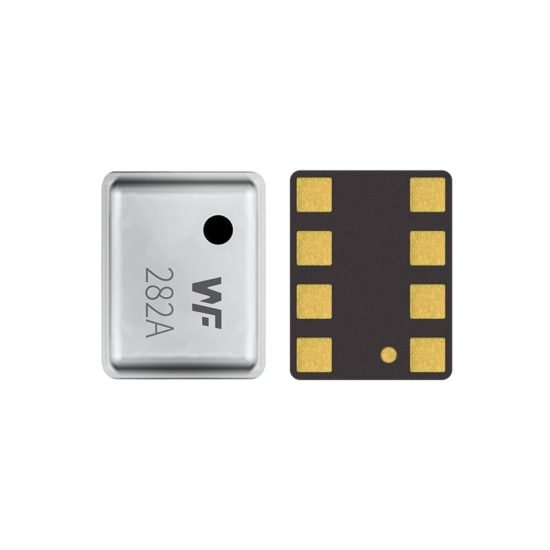
WF 282A sensor adopts compact design with small dimensions, facilitating installation in the limited space of electric pressure cookers. The sensor’s standardized interface design makes installation simple and quick, allowing maintenance personnel to easily complete sensor replacement and maintenance work. The sensor’s four metal contact points provide reliable electrical connections, ensuring signal transmission stability. This compact design not only saves space but also reduces overall system costs, enabling advanced sensor technology to be widely applied in household electric pressure cookers.
Conclusion
Sensor technology plays a core role in electric pressure cooker gas pressure sensitive force control, achieving precise monitoring and control of pressure inside the pot through multiple technical means including displacement detection, temperature compensation, and safety control. WF 282A MEMS pressure sensor, with its excellent high-temperature resistance, high-precision measurement capability, and reliable signal processing technology, provides a solid technical foundation for safe operation and efficient cooking of electric pressure cookers. With continuous development of sensor technology, future electric pressure cookers will achieve more intelligent and personalized cooking control, bringing users better cooking experiences.
L’introduction ci-dessus ne fait qu’effleurer la surface des applications de la technologie des capteurs de pression. Nous continuerons à explorer les différents types d’éléments capteurs utilisés dans divers produits, leur fonctionnement ainsi que leurs avantages et inconvénients. Si tu’D Like plus de détails sur ce’Comme discuté ici, vous pouvez consulter le contenu associé plus loin dans ce guide. Si vous êtes pressé par le temps, vous pouvez également cliquer ici pour télécharger les détails de ce guide Données PDF du produit du capteur de pression d'air.
Pour plus d'informations sur d'autres technologies de capteurs, veuillez Visitez notre page de capteurs.

