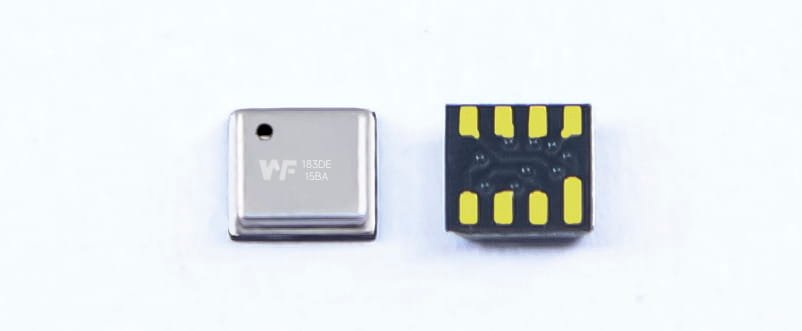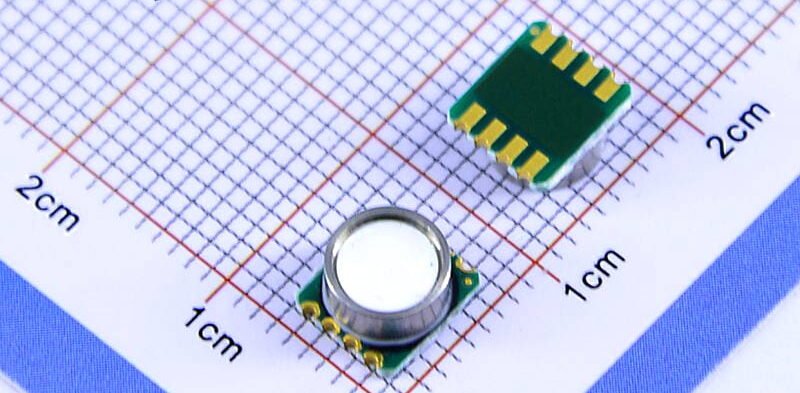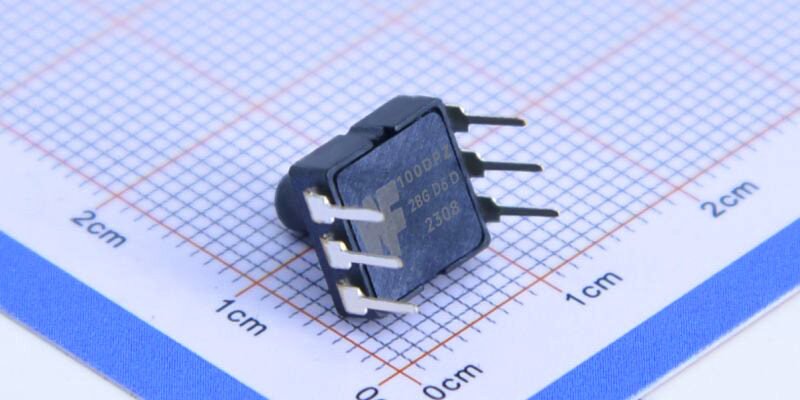
Off-the-shelf chips can’t extract MEMS weak signals; ASICs bespoke to sensor physics reduce noise to industry-leading levels and enable 24-bit accuracy across extreme temperatures. By co-designing signal chains, thermal compensation, and power control, ASICs convert fragile MEMS elements into robust, dependable components for TPMS, wearables, and smart factories, meeting stringent reliability and lifetime requirements.
Каталог
1. The Essence of ASIC Pressure Sensors
When sensing precision leaps, backend complexity explodes. MEMS outputs (femtofarads) are vanishingly small and require minimal parasitics and bespoke circuitry. ASICs eliminate unnecessary generic blocks, match circuit topology to MEMS mechanics, and optimise performance vs. power, enabling the tiny signals to be amplified and digitised without drowning in noise or distortion.
1.1 Performance Leaps Through ASIC Customisation
Generic analogue front ends waste area and raise parasitics; ASICs co-design circuits with MEMS mechanics to match impedances and preserve linearity. On-chip temperature sensing and rapid compensation algorithms reduce drift dramatically. The result: far smaller drift and superior linearity and accuracy over wide pressure and temperature ranges compared with discrete solutions.
1.2 Fundamental Differences from Generic Chip Solutions
Universal chips require configurable ADCs and op-amps, adding parasitics and area; ASICs strip that away and reallocate resources to noise and stability. Real-world swaps show power drops, area shrinks, and accuracy jumps (e.g., TPMS examples). Discrete components and PCB parasitics form hard physical limits that ASIC co-design can overcome.
2. Weak Signal Processing
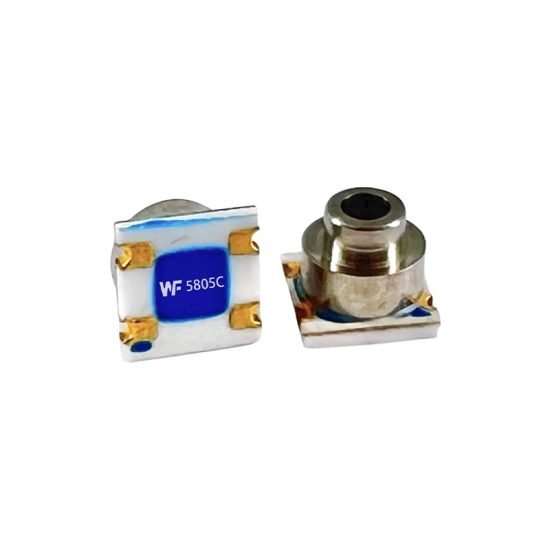
MEMS sensor signals are extremely small (sub-millivolt after conversion) and traverse multiple noisy stages. Each added element increases cumulative noise and error. ASICs compress stages, integrate precise capacitors and PGAs, and use architectures like switched-capacitor integration and correlated sampling to preserve signal integrity through to the ADC.
2.1 Millivolt-Level Signal Conversion Challenges
Conventional op-amp chains introduce bias and offset errors at high-impedance nodes. ASICs use single-stage switched-capacitor charge integration, correlated double sampling, low-TC capacitor arrays, and dynamic element matching PGAs. These reduce gain error and drift, enabling ENOBs above 21 bits and Pa-level resolution in 24-bit sensor systems.
2.2 Temperature Compensation Sensor Implementation Mechanisms
Piezoresistive sensitivity drifts strongly with temperature. ASICs embed temperature sensors, ADCs and microcontrollers to run multi-point polynomial compensation in real time. Storing calibration at multiple temperatures and interpolating on-chip yields sub-0.1% accuracy across wide thermal ranges with minimal extra power overhead.
2.3 Precision Assurance in Extreme Environments
Harsh automotive and downhole conditions expose generic chips to leakage, electromigration, and drift. ASICs adopt high-temperature CMOS, tailored doping, and stress-isolation layout to suppress leakage and maintain thresholds. Well-designed ASICs preserve noise floors and amplifier performance even at elevated temperatures, ensuring stability in extreme deployments.
3. Ultra-Low Noise Architecture
System noise is the sum of mechanical Brownian noise and electronic noise. ASICs target thermal, flicker and quantisation noise through chopper-stabilised front ends and Σ-Δ noise shaping. By pushing 1/f noise and quantisation artefacts out of band and using aggressive decimation, ASICs free the ADC’s lower bits for actual signal, enabling true high dynamic range.
3.1 High-Resolution Secrets of 24-Bit Pressure Sensors
Practical 24-bit performance requires front-end noise far below ADC least significant bits. ASICs pair chopper amplifiers, high-order Σ-Δ modulators with high oversampling and digital decimation filters to reach very low integrated RMS noise while keeping ADC power modest—achieving sub-Pa RMS and medical-grade accuracy at microamp power levels.
3.2 Actual Performance of Noise Suppression Techniques
Chopper stabilization reduces 1/f noise but brings charge injection and clock feedthrough issues. ASICs mitigate these via complementary/dummy switches and correlated sampling, cutting injected charge to sub-fC levels. Measured results show dramatic bandgap and amplifier noise improvements even at high temperatures, shifting the noise floor toward fundamental mechanical limits.
4. Balancing Power and Size
Wearables demand ultra-low average current and tiny modules. ASICs implement wake-on-demand power domains, tiny RTCs and threshold wake comparators to keep deep-sleep current at single-microamp levels while enabling fast wake and capture. This duty-cycling, combined with dense integration, yields multi-year battery life in millimetre-scale packages.
4.1 How 50 Microamp Standby Current Is Achieved
Low-power ASICs split operation into deep sleep, standby, and active modes. Only essential clocks and wake comparators run in sleep; fast wake and brief active bursts minimise duty cycle. With microsecond wake times and millisecond captures, average current falls to single-digit microamps, enabling years of operation on small button cells in practical monitoring modes.
4.2 Integration Density of 2 Square Millimetre Chips
Area reduction stems from multiplexing analogue resources and heterogeneous integration: time-division of a single precision op-amp, smaller bandgaps and ADC optimisations. Stacking digital logic above analogue dies with TSVs and process mix saves silicon footprint. The result: sub-2 mm² ASICs that include ADCs, filters, interfaces and power management suitable for compact products.
5. From Piezoresistive Sensors to Intelligent Systems
ASICs turn simple transducers into smart edge nodes by integrating MCUs, calibration data, filters and comms. On-chip processing delivers filtered, compensated digital pressure values and event detection, reducing data traffic and enabling local decision-making. This increases robustness, lowers system power and simplifies integration for end products.
5.1 Real-Time Data Processing in TPMS Applications
TPMS ASICs sample frequently but only transmit summaries; embedded algorithms filter vibration artefacts, compute leak rates, and decide when to wake RF for alerts. Local processing slashes transmission duty cycle and RF power, extending battery life to vehicle lifetimes while maintaining rapid, reliable detection of hazardous pressure events.
5.2 Pressure Monitoring Solutions in Industrial IoT
ASIC-enabled differential sensors provide consistent, threshold-based alerts for HVAC and filter monitoring. Built-in comparators and stored calibration eliminate false alarms and shorten response latency. Integrated intelligence cuts system cost versus PLC-based setups and enables reliable, low-maintenance deployments with measurable savings and long runtimes.
Заключэнне
ASIC development redefines MEMS pressure sensing: ultra-low noise, tight thermal compensation, and micro-power operation produce highly accurate, compact, and durable sensors. ASIC co-design solves weak-signal, nonlinearity, and longevity challenges, enabling commercial, automotive, medical, and industrial applications with improved cost, size, lifetime, and IP protection.
Прыведзенае вышэй увядзенне толькі драпае паверхню прымянення тэхналогіі датчыка ціску. Мы працягнем вывучаць розныя тыпы сэнсарных элементаў, якія выкарыстоўваюцца ў розных прадуктах, як яны працуюць, а таксама іх перавагі і недахопы. Калі вы жадаеце атрымаць больш падрабязную інфармацыю аб тым, што тут абмяркоўваецца, вы можаце праверыць адпаведнае змесціва далей у гэтым кіраўніцтве. Калі ў вас няма часу, вы таксама можаце націснуць тут, каб загрузіць падрабязную інфармацыю аб гэтым даведніку Датчыкі датчыка ціску паветра PDF дадзеныя.
Для атрымання дадатковай інфармацыі аб іншых сэнсарных тэхналогіях, калі ласка Наведайце старонку датчыкаў.