
- بواسطة أجهزة استشعار WF
This article zeroes in on waterproof air pressure sensors and how they’re applied in electronic devices. It walks through fundamentals, packaging and structure, key performance metrics, system integration and reliability testing — all with an eye to keeping the sensor exposed to the external atmosphere while still meeting high ingress protection. I compare piezoresistive sensors and capacitive sensors, discuss metal-lid and gel-filled protection designs, and outline engineering recommendations such as temperature compensation, digital interfaces and SMD mounting considerations. The content leans on MEMS/ASIC packaging details and manufacturing practice so it’s useful for implementation in smartwatches, drones, robotic vacuums and medical inhalers.
كتالوج
1. Air pressure sensor basics (definition, types and main uses)
Air pressure sensors measure atmospheric pressure and altitude changes — they convert environmental pressure into a readable signal. MEMS-based sensors mainly come in two flavours: مقاوم للضغط و تسعية. Piezoresistive units rely on resistance changes, useful in some specific ranges; capacitive types detect diaphragm displacement as capacitance change and typically offer lower noise and lower power consumption, which is why they’re common in portable devices.
A typical sensor assembly includes a MEMS diaphragm, ASIC front-end, a metal lid and internal protective filler, and it outputs temperature-compensated pressure readings via digital interfaces. Applications span smart phones and smartwatches for elevation and floor counting, drones for altitude hold, vacuum cleaners for suction monitoring and inhalers for flow statistics. For integration into consumer electronics, sensors must be compact, low power, suitable for SMD mounting and designed so they can still exchange air with the outside while being waterproof — that’s key to accurate and reliable readings.
Primary uses and performance metrics
Key metrics are resolution, noise, temperature drift, response time, shock resistance and interface latency. Portable devices favour capacitive sensors for their lower noise and lower power draw; piezoresistive solutions still hold advantages in certain industrial or high-range scenarios. When you evaluate parts, check temperature compensation accuracy, I2C/SPI output stability and long-term drift in damp or dusty environments. Designers must balance accuracy, power and cost to pick the right device and packaging.
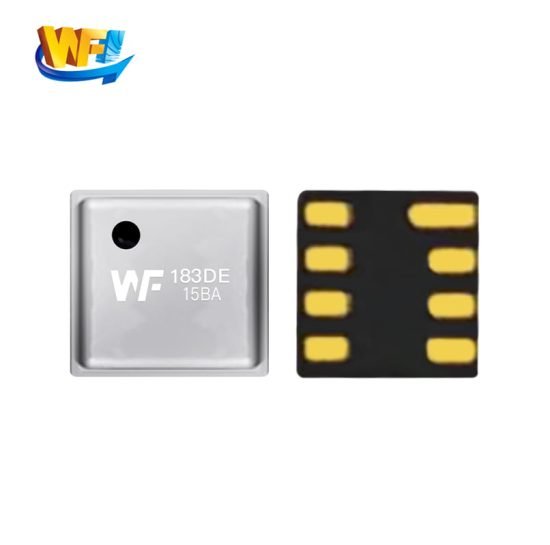
2. Waterproof structure and working principle (packaging essentials and pressure path)
The crux of a waterproof air pressure sensor is this: keep the electronics dry while letting the diaphragm sense outside pressure. Practically, you put the MEMS die and ASIC under a metal lid and fill the interior with a protective gel or filler that blocks water yet allows controlled pressure transfer. An O-ring at the housing interface often seals the package to the device enclosure. The MEMS diaphragm senses pressure transmitted through the gel (or via a tiny venting path), so you preserve high waterproofing without isolating the sensor from the atmosphere. Seal materials, bonding and filler properties directly affect response time and long-term stability.
In design, pay attention to the cross-sectional profile, material elasticity, permeation of gases through the filler, and the sealing consistency where the sensor meets the device housing. A well-designed air path avoids the lag or offset you’d get from a fully sealed sensor, while still coping with humidity and temperature cycling.
How waterproofing affects measurement accuracy
Achieving water resistance while leaving a pressure path means the filler’s elastic properties and gas diffusion rates influence dynamic response. The way the sensor is clamped to the device influences long-term leakage behaviour. Engineers verify drift and offset using accelerated humidity and immersion testing, and mitigate any residual effects with temperature sensing and compensation at the ASIC level so the sensor keeps providing accurate readings over time.
3. Key technical specs and interfaces
To deploy a waterproof air pressure sensor reliably you must align sensor specs with system needs. The device should deliver low noise, solid temperature compensation, high resolution sampling and common digital interfaces (I2C or SPI) plus interrupt capabilities to save MCU power. Having a temperature sensor inside the ASIC and outputting temperature-compensated pressure simplifies integration — you get near-ready data straight from the sensor. SMD packaging and interrupt/FIFO features make host software simpler and lower power use.
When choosing a part, check zero offset, sensitivity temperature coefficient, long-term drift (e.g. ppm/year or Pa/year), transient response and shock tolerance. In environments with strong EMI, check EMC performance and ensure your digital lines preserve signal integrity.
Calibration and temperature compensation strategies
Parts usually get two-point or multi-point factory calibration with coefficients loaded into the ASIC. In the field, the built-in temp sensor plus runtime compensation keeps sensitivity and offset in check. For high-accuracy uses, add system-level self-checks and occasional software zeroing, and monitor operation in extreme humidity or temperature to catch any creeping drift.
4. Application scenarios: implementation notes from a sub-device viewpoint
Waterproof air pressure sensors perform critical tasks across many sub-devices:
In smartwatches they handle elevation tracking, stair counting and fall detection. Because the watch case needs protection, the mechanical fit between sensor package and case is crucial to let the sensor breathe while staying waterproof.
On drones they support altitude and attitude control; here you need fast response, low mass and robust shock tolerance, so packaging must keep water out without adding aerodynamic disturbance.
In robotic vacuums and projectors, pressure readings are used for suction monitoring and filter-clog detection — these rely on long-term stability and contamination resistance.
In medical inhalers, pressure changes log use counts and flow; these parts must meet strict cleaning and biocompatibility checks.
Integration considerations in device systems
When integrating, decide sensor placement to avoid dead air pockets, keep the pressure transmission path short and avoid kinks, and design grounding and shielding to reduce noise. If the device shell is metal, provide local insulation or a non-conductive channel to prevent shorts or noise pickup. For ultra-low power products, tune sampling rates and interrupt thresholds so you get prompt events without draining battery.
5. Reliability testing and manufacturing essentials
Factory process control defines how a waterproof sensor behaves in end devices. Tests include visual and internal cavity checks, filler consistency, thermal cycling, damp heat ageing, salt spray/immersion, vibration and shock, and long-term drift monitoring. Products claiming high protection grades must back that up with representative test data demonstrating acceptable leak rates and performance degradation. On the production line, you need first-article inspection, in-process controls and function tests before shipment. Traceability for MEMS dies and ASICs, batch control for packaging materials and solder reliability are all crucial.
If tests show drift, trace the cause to bonding, filler density or clamp torque and tighten the process to eliminate leaks or mechanical relaxation.
Production quality control essentials
QC covers incoming material checks, critical dimension verification, AOI for packaging defects and statistical analysis of aging tests. Run representative immersion and airtightness checks per batch, lock key process parameters into production specs, and track process capability (Cp/Cpk) to keep shipped devices consistent and reliable.
خاتمة
From the sub-device perspective, a waterproof air pressure sensor must balance protection and pressure accessibility. With the right packaging approach — metal lid plus gel fill and O-ring sealing — combined with sound temperature compensation, digital interface support and strict manufacturing tests, you can deploy accurate and robust pressure sensing in smartwatches, drones, home robots and medical gear. Teams should focus on long-term drift, compensation accuracy and interface stability, and make thoughtful mechanical and electrical integration choices. Those steps let you keep a high protection grade while retaining high-quality external pressure sensing.
المقدمة أعلاه لا تخدش سوى سطح تطبيقات تكنولوجيا استشعار الضغط. سنستمر في استكشاف الأنواع المختلفة لعناصر المستشعر المستخدمة في المنتجات المختلفة وكيفية عملها ومزاياها وعيوبها. إذا كنت تريد مزيدًا من التفاصيل حول ما تمت مناقشته هنا، فيمكنك الاطلاع على المحتوى ذي الصلة لاحقًا في هذا الدليل. إذا لم يكن لديك وقت كاف، يمكنك أيضًا النقر هنا لتنزيل تفاصيل هذه الأدلة منتجات استشعار ضغط الهواء PDF بيانات.
لمزيد من المعلومات حول تقنيات الاستشعار الأخرى، من فضلك قم بزيارة صفحة أجهزة الاستشعار لدينا.


